


FIELD NOTES
Jensen Huang is out after 33 years. Employees are campaigning to bring him back. An internal post urging the board to consider employee sentiment attracted more than 1,600 comments, mostly supportive of Huang. A separate public petition has drawn more than 100,000 signatures, including thousands of self-identified Nvidia employees.
Meanwhile, the board includes longtime venture capitalists, a former NFL marketing chief, a former Taco Bell International president, and a Caltech professor. But replacing Jensen may be one of the most unusual jobs in corporate history.
That’s because Huang wasn’t simply running a semiconductor company. He was personally helping orchestrate the supply and demand for an entire industry.
Take TSMC. Huang spent three decades cultivating a relationship with founder Morris Chang, securing the manufacturing partnership that underpins Nvidia’s chips today. In an interview with Dwarkesh Patel earlier this year, he explained how he personally persuaded suppliers to make enormous investments in capacity years ahead of demand.
His pitch was simple: Nvidia had the customers to buy whatever its suppliers could produce. And those customers, in turn, could count on Nvidia to deliver the compute they needed.
Over time, Nvidia became much more than a chipmaker. It invested in suppliers, backed AI labs, financed cloud operators, committed to buying unused compute capacity and guaranteed certain data center leases.
The result is an extraordinary web of commercial and financial relationships stretching across almost every layer of the AI compute economy.
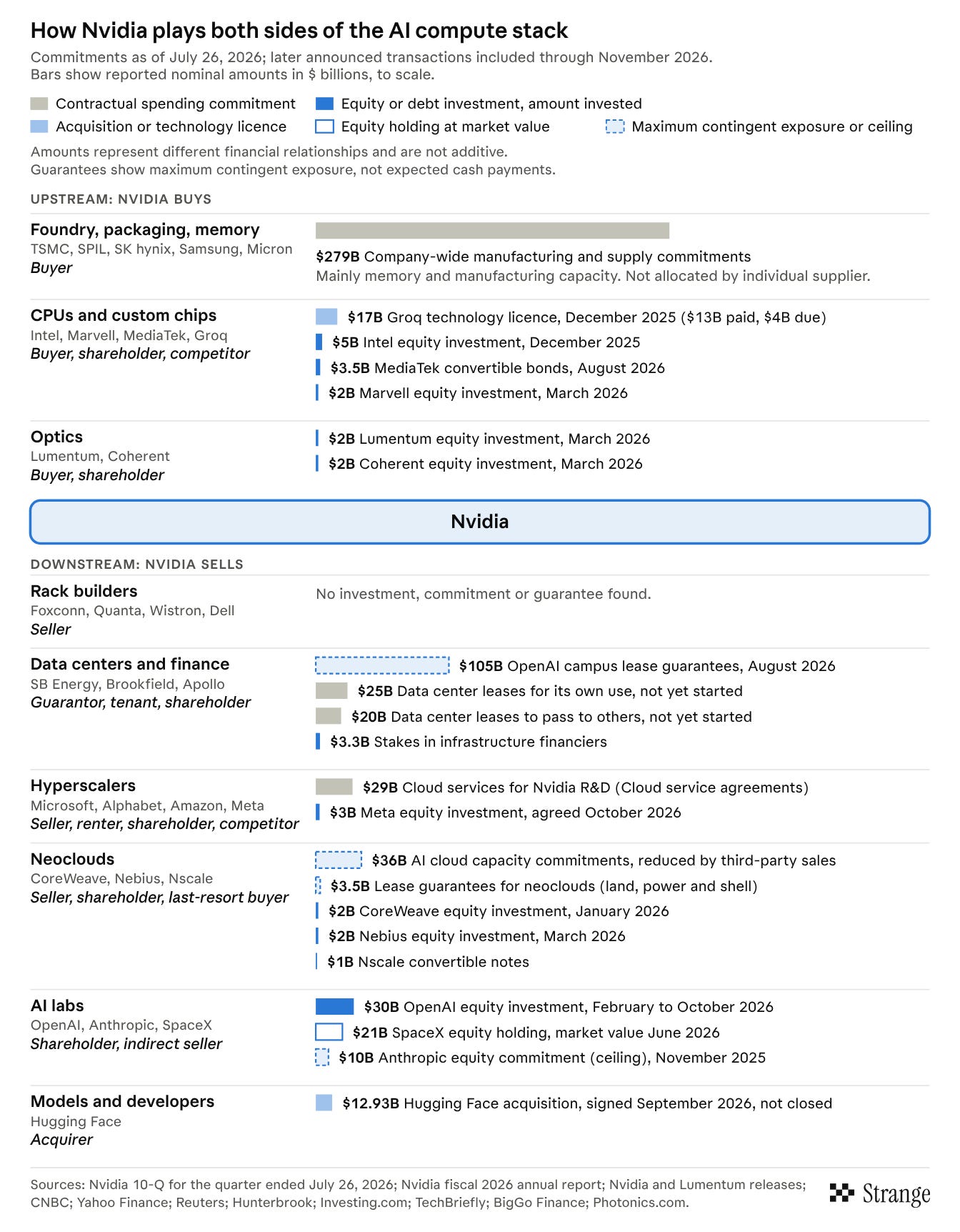
In many ways, it’s a brilliant solution to the industry’s chicken-and-egg problem. Suppliers need confidence in future demand before expanding capacity. Customers need confidence in future supply before committing billions to infrastructure. Nvidia has increasingly helped make both sides happen.
It is also a system built around an unusually influential individual.
Nvidia’s technological advantages won’t disappear overnight. Its engineers, CUDA ecosystem, manufacturing partnerships and customer contracts remain. But much of the company’s extraordinary reach was built through Huang’s personal relationships, powers of persuasion and ability to get entire industries moving in the same direction.
And now, just as AI is beginning to challenge some of Nvidia’s traditional software advantages, its greatest human advantage is gone.
Did Jensen build an AI ecosystem powerful enough to run without him? I think it’s still very much in its early days.
-Tara
THE DOWNLOAD
Nvidia’s Jensen Huang resigns after 33 years at the helm
Nvidia announced Jensen Huang’s resignation on Thursday, ending his 33-year tenure as CEO of the company he co-founded. His departure took effect November 11, according to the company’s SEC filing.
CFO Colette Kress has been appointed interim CEO, while longtime director Harvey Jones becomes Nvidia’s first board chair. The company is searching for a permanent successor. Huang’s departure follows a week of scrutiny over allegations concerning his personal relationships and national-security questions. Nvidia’s filing does not specify a reason for his resignation.
Why it matters: Huang was more than Nvidia’s CEO. He was its chief salesman, strategist and political advocate, helping turn a chipmaker into the company at the center of the AI boom. Now comes the first test of how much of that influence can survive without him.
SpaceX catches Starship returning from orbit for the first time
SpaceX successfully caught its Starship upper stage with the giant mechanical arms of its launch tower on Saturday, November 14, after the spacecraft spent more than 22 hours in space.
Starship completed 14 orbits of Earth and deployed 26 Starlink V3 satellites before returning to its launch site in Texas. It marks the first recovery of a Starship upper stage following an orbital flight.
The mission wasn’t a complete success. SpaceX had hoped to recover both rocket stages, but the Super Heavy booster aborted its landing attempt and was destroyed over the Gulf of Mexico.
Why it matters: Recovering an orbital upper stage is a major step toward fully reusable rockets. SpaceX still needs to demonstrate that a recovered Starship can fly again, but it has now cleared one of the hardest engineering hurdles.
Google introduces a new generation of models for reasoning and agents
Google made Gemini 4 Carbon available this week, followed by Gemini 4 Hydrogen, a faster, cheaper model for everyday coding and agent workflows. Carbon is designed for more demanding reasoning, scientific research and long-running tasks.
More interesting is Google’s new Orchestrator, which dynamically switches between models during a task. On Terminal-Bench 4.0, Google reports nearly Carbon-level task success while using 24% less quota and finishing 19% faster. It’s also previewing /swarm, which coordinates multiple agents working in parallel.
AI mathematically verifies the code protecting Signal messages
Google DeepMind introduced AlphaProof Code, an AI-agent system that helped formally verify key security properties of Signal’s cryptographic implementation.
Human researchers defined and reviewed the specifications, while AI agents generated approximately 6.5 million lines of machine-checked proofs in four weeks. The team also reintroduced two previously fixed vulnerabilities; the system correctly identified both as insecure. The proofs establish specific properties of the code, rather than guaranteeing that the entire application is free of vulnerabilities.
Formal verification has historically been so labor-intensive that it’s rarely practical for production software.
Microsoft’s global outage exposes the fragility of enterprise infrastructure
A major Microsoft 365 outage disrupted Outlook, Teams-dependent features, Copilot and security tools for enterprise customers last week.
Microsoft traced the problem to an earlier network-capacity upgrade, which introduced a fault that surfaced following a subsequent network change. As servers became unavailable, dependent services experienced disruptions. Recovery took more than a day, with Microsoft gradually restoring capacity and clearing backlogs. The company says the incident was not caused by a cyberattack.
Why it matters: Enterprise software increasingly runs on interconnected platforms. A problem in the underlying infrastructure can take down services that appear unrelated, from email to security administration. As companies hand more work to AI agents operating on these same systems, we might see legacy reliability become an even more consequential dependency.
Advanced nuclear takes a step toward the factory floor
Dow and X-energy received a construction permit for four proposed advanced nuclear reactors at Dow’s chemical manufacturing complex in Seadrift, Texas.
The reactors would supply both electricity and high-temperature steam, replacing conventional industrial energy infrastructure. It’s the first US construction permit for a high-temperature gas-cooled reactor in nearly 60 years, and the first advanced nuclear facility approved for construction at an industrial site.
The permit doesn’t mean construction is assured. Dow still needs to finalize engineering work, secure board approval and eventually obtain a separate operating license.
Why it matters: Nuclear’s next major market may be the factory, where manufacturers need reliable electricity and high-temperature heat around the clock.
ALSO
Anthropic releases Claude Fable 5.2 and Mythos 5.2. The two versions share an underlying model, with different safeguards and access rules. Anthropic says the models improve performance in coding, scientific research and hardware design, while generating output up to 30% faster than their predecessors.
Google’s AlphaGenome 2 predicts how DNA variants affect specific cell types. Trained on more than 100 million cell profiles, the model identifies nearly twice as many gene-expression-changing variants as its predecessor, according to DeepMind.
Anthropic brings Claude into meetings. Claude Meetings, now in beta, can join Google Meet calls, answer questions and produce documents or whiteboards while people are still talking.
Japan plans to use data center waste heat to farm shrimp. NTT Docomo Business and three partners will test whether heat recovered from server cooling systems can warm land-based aquaculture tanks. Actual shrimp cultivation is planned for 2027.
Blackstone-backed QTS reportedly cuts an AI infrastructure debt sale by 60%. Bloomberg reports the data center operator reduced a proposed private placement from roughly $800 million to $300 million after struggling to attract investors at its preferred terms. It’s a potentially revealing sign of tighter financing conditions.