


FIELD NOTES
The finite game of being the frontier AI model just got even more finite. A few hours after I wrote a breakdown on Mythos / Fable and how the economics of building frontier intelligence are being squeezed (the models are immediately distilled by Chinese companies upon release, which made Anthropic baked in a safety layer that made Fable 4x more expensive than the previous model, Opus). Then, in a strange turn of events, the US government pulled the plug on the model entirely, citing export controls, likely due to suspected Chinese access to Mythos. Since Anthropic couldn’t KYC everyone accessing the model, they removed access for all users overnight.
This is unprecedented. And it makes me think of a few things:
US frontier models may be forced to KYC every developer and user. That is probably a death knell to user growth.
Because of economic and political pressures on model training, I predict closed-source model companies will start to aggressively move up the stack toward the application layer. They can easily beat out competition on the app layer with token unit economics alone.
The ecosystem and inference infrastructure around supporting multiple models will be more important than ever. If you’re building in this space, please reach out!
-Tara
THE DOWNLOAD
US Government Orders Anthropic to Disable Fable 5 and Mythos 5
The Commerce Department issued an emergency export-control directive Friday evening barring foreign-national access to Anthropic’s Fable 5 and Mythos 5, launched three days earlier. Because Anthropic cannot screen citizenship in real time, it pulled both models for every customer worldwide. The directive extends to Anthropic’s own foreign-born staff; Reuters notes that co-founder Chris Olah, researcher Andrej Karpathy, and philosopher Amanda Askell were all born outside the US, and Anthropic declined to say whether they have been locked out of the models they help build. David Sacks called the jailbreak “easily resolved” and denied any link to prior disputes; Semafor reports Amazon’s CEO Jassy tipped off the government and the real trigger was suspected Chinese access to Mythos.
Why it matters: This is the first time the federal government has taken a publicly deployed commercial model offline. It sets a precedent: any model accessible via API can be shut down for all users, worldwide, in hours, by directive.
SpaceX Completes Largest IPO in History at ~$2.2 Trillion
SpaceX listed on Nasdaq Friday at $135 per share, the largest IPO in history, surged past $170, and reached a market cap of roughly $2.2 trillion, passing TSMC and Saudi Aramco to become the sixth-most-valuable public company. Investor demand was nearly 4x the $75 billion offering.
Why it matters: Musk successfully pivoted the SpaceX narrative from space to an AI infra company in the months before listing. The S-1 frames three business lines: rockets, connectivity, and AI compute. SpaceX has existing compute contracts with Alphabet and Anthropic, COO Gwynne Shotwell told CNBC SpaceX “100 percent” sees itself competing with the neoclouds, and Musk’s comp is tied to delivering space-based AI data centers (even if whether orbital compute actually works at scale is unproven).
Apple Rebuilds Siri on a Licensed Google Gemini Model
At WWDC this week, Apple unveiled “Siri AI” running on a custom 1.2-trillion-parameter Gemini model licensed from Google for a reported ~$1B/year. iOS 27 will also let users route Siri requests to third-party chatbots including Claude and Gemini via a new Extensions system. This was Tim Cook’s final WWDC as CEO before handing the role to hardware chief John Ternus on September 1.
Why it matters: The most valuable consumer-hardware company is choosing to lease its frontier model from a direct rival. The third-party Extensions system goes further: Apple is explicitly positioning as an orchestration and distribution layer above the models, not a model builder. That hands Google a recurring revenue stream inside every iPhone. (Editor’s note: we predicted this nearly 10 months ago!)
OpenRouter Launches Fusion API
OpenRouter launched Fusion, a system that runs a panel of different LLMs against the same prompt in parallel, then passes their outputs to a judge model that synthesizes a single answer. In benchmarks on Perplexity’s DRACO deep-research suite, Fable 5 and GPT-5.5 fused together scored 69%, beating every individual frontier model tested. A same-model panel (Opus 4.8 paired with itself) still jumped 6.7 points over Opus 4.8 alone.
Why it matters: The biggest gains came from the synthesis step itself, not from mixing different model architectures. This means that a thin orchestration layer that recombines outputs from commodity models can match or beat a single frontier model at lower cost.
Chan Zuckerberg Biohub Releases Open-Source ESMFold2
The Chan Zuckerberg Biohub released ESMFold2, an open-source protein AI model trained on 2.8 billion sequences, alongside the ESM Atlas: 1.1 billion predicted protein structures and 6.8 billion sequences, exceeding AlphaFold’s database by over 800 million entries (Nature). This is not just a prediction tool. Biohub used ESMFold2 to computationally design protein binders against five cancer and immunology targets (including PD-L1 and EGFR), then validated them in the lab, matching the mechanism of approved therapies (Biohub).
Why it matters: The step from prediction to design-and-validate is the one that matters commercially. DeepMind’s Isomorphic Labs is building a business around that exact transition behind a closed model. ESMFold2 ships it open-source with lab-validated therapeutic results, which compresses the moat to downstream wet-lab data, proprietary targets, and clinical execution rather than model access.
Amazon Discloses 2.5 Billion Gallons of Data-Center Water Use
Amazon reported its data centers withdrew about 2.5 billion gallons of water globally in 2025, its first absolute figure, roughly 5% of metro Seattle’s annual use (Bloomberg). The company claims 7x better water efficiency than the industry average, though that comparison measures its full fleet against Google’s AI-specific facilities.
Why it matters: The 2.5B figure is operational water only and excludes the far larger volume embedded in power generation. With EPA rules and eight states tightening data-center water regulations in 2026, water is becoming a real siting and permitting constraint on the AI buildout, on par with power and land.
DEEP DIVE FROM THE REVIEW

EVENTS
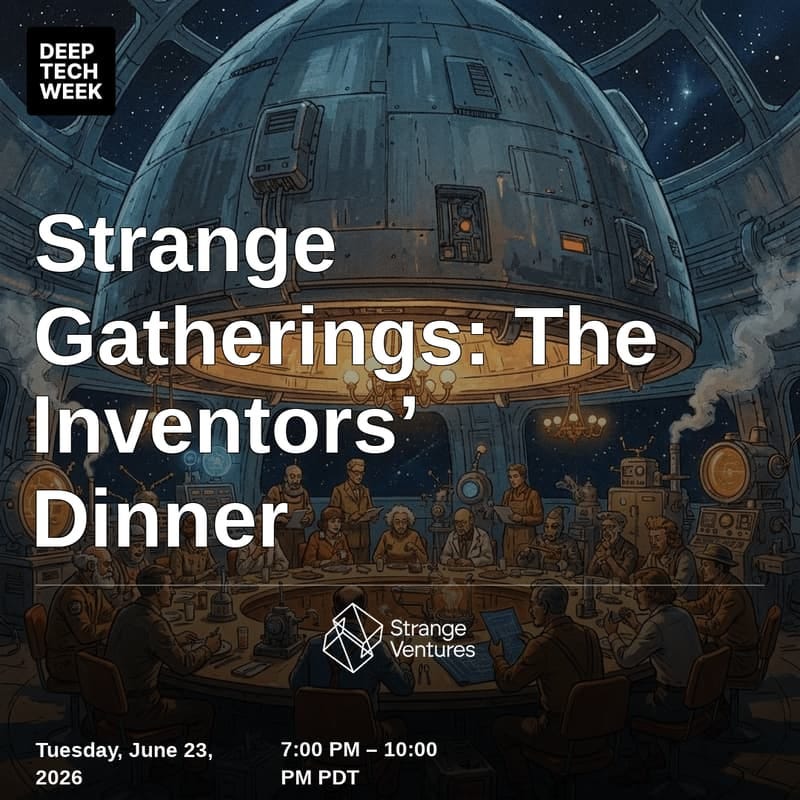
As part of Deep Tech Week, Strange Ventures is hosting a private dinner for a small group of scientists , researchers, and founders.
We’ll gather around a Jeffersonian table to discuss the breakthroughs, discoveries, and ideas that may shape the next decade.
Strange Sessions #5: Loops
Strange Sessions is a monthly demo night where builders share what they’re working on.
Each session revolves around a theme and features short demos from founders, researchers, and creative technologists.
Early ideas welcome.