


FIELD NOTES
A few months ago, I wrote about the finite game of being first. My argument was that frontier intelligence is enormously valuable, but the advantage is temporary. Each new model buys its creator a window of superiority before competitors catch up. Then the race starts again.
I wondered what the economics of that race would look like. This week, we got a much clearer picture.
Anthropic is preparing to go public. Its confidential IPO prospectus, reviewed by Reuters, and new financial disclosures reported by the Financial Times reveal something extraordinary: one of the fastest-growing technology businesses we’ve ever seen, alongside infrastructure commitments on a scale usually associated with entire industries.
I spent some time digging into the numbers. They tell a more interesting story than either the AI bulls or bears might suggest.
First, the revenue is staggering.
Anthropic generated approximately $4.6 billion in revenue in all of 2025. By the third quarter of 2026, it was generating $16.8 billion in a single quarter.
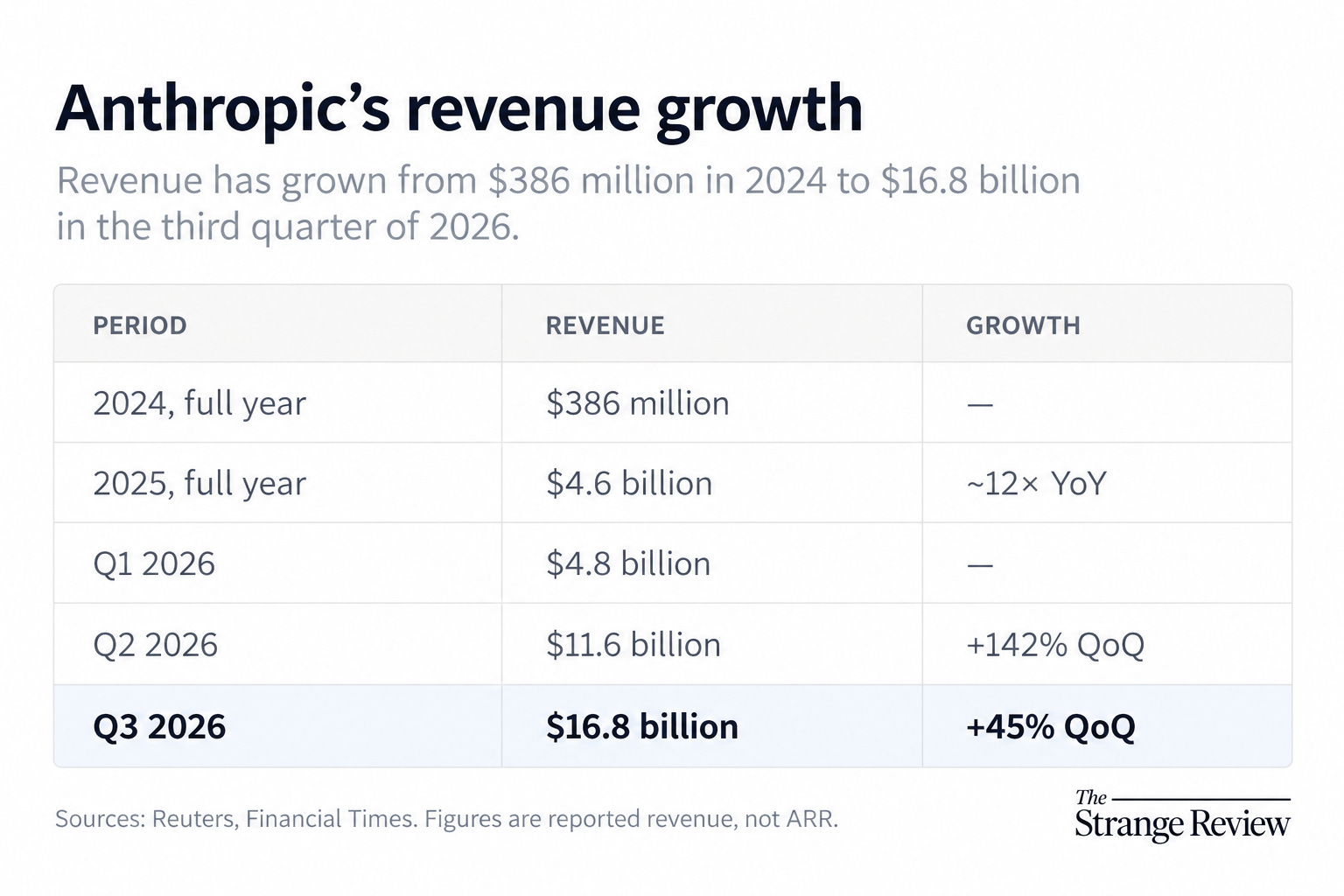
Sources: Reuters, FT. Figures are reported revenue, not ARR.
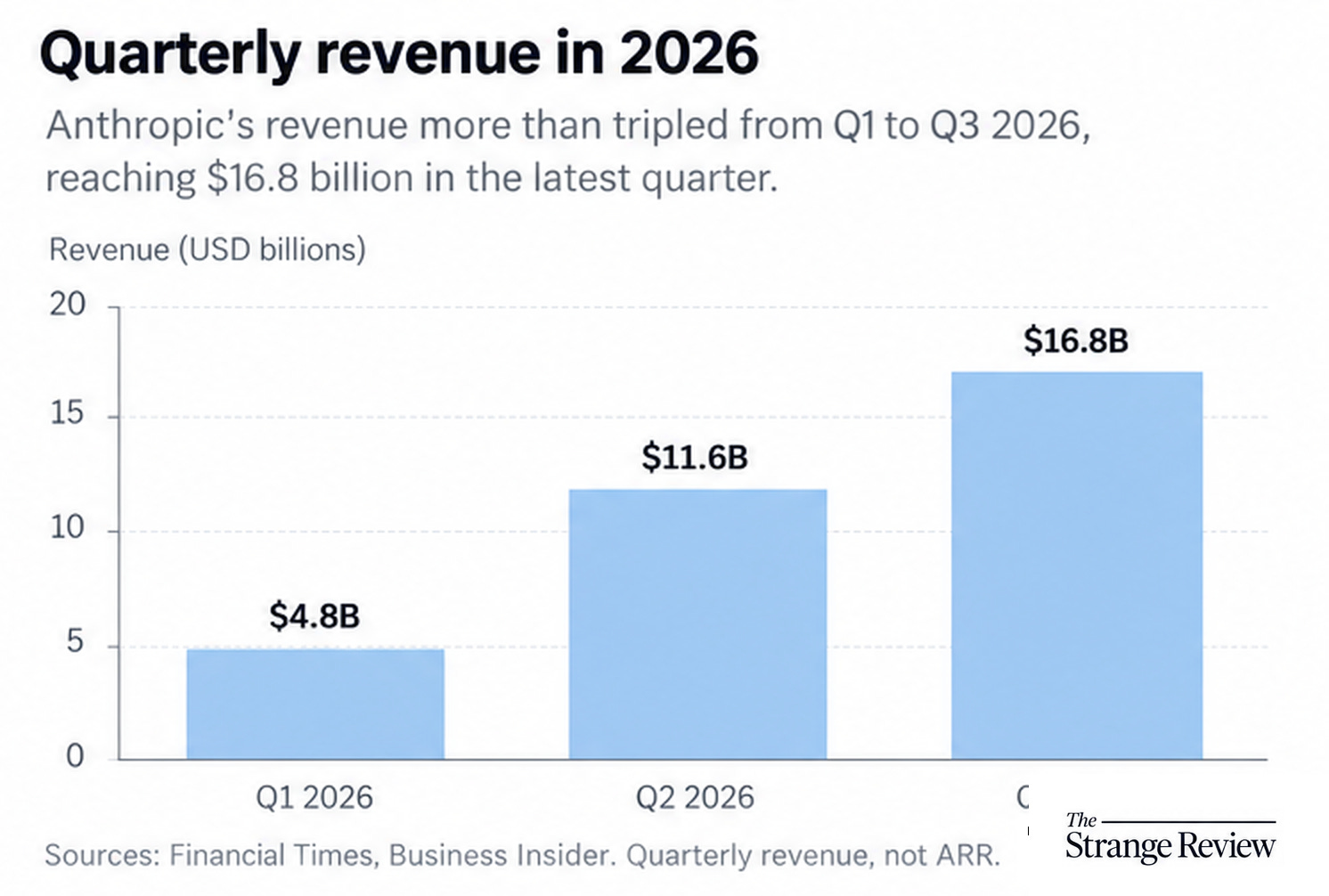
That’s an annualized revenue pace of $67.2 billion, although annualizing one quarter is not the same as forecasting the next twelve months.
Growth has slowed from 142% quarter-on-quarter to 45%. But describing 45% quarterly growth at this scale as disappointing feels absurd.
More interestingly, Anthropic is beginning to demonstrate operating leverage.
The economics have improved dramatically.
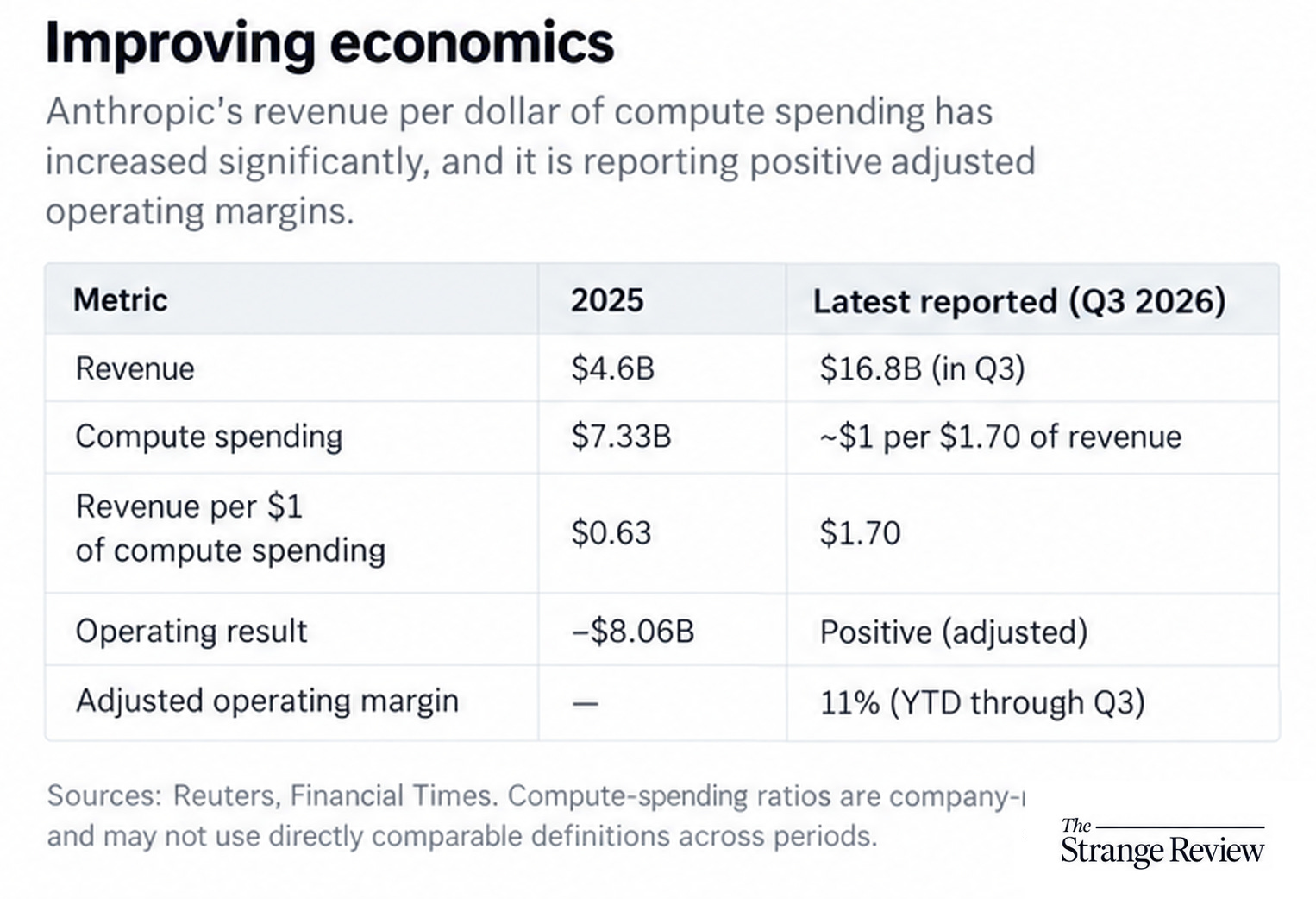
Sources: Reuters’ examination of the draft prospectus, FT’s investor-day reporting.
In 2025, Anthropic spent roughly $1.60 on compute for every dollar of revenue. Its latest reported ratio is approximately $0.59 per revenue dollar.
That’s a remarkable improvement, although compute spending isn’t the same as total cost of revenue. And the reported 11% operating margin is adjusted, not GAAP profitability.
Still, these numbers challenge the idea that frontier AI will necessarily remain a permanently loss-making business.
Now look at what it costs to stay in the race.
According to Reuters, Anthropic’s draft prospectus details at least $518 billion in compute and infrastructure commitments over approximately a decade, roughly 80% of which are described as noncancelable or payable regardless of usage.
These are future contractual obligations, not outstanding debt or money already spent.
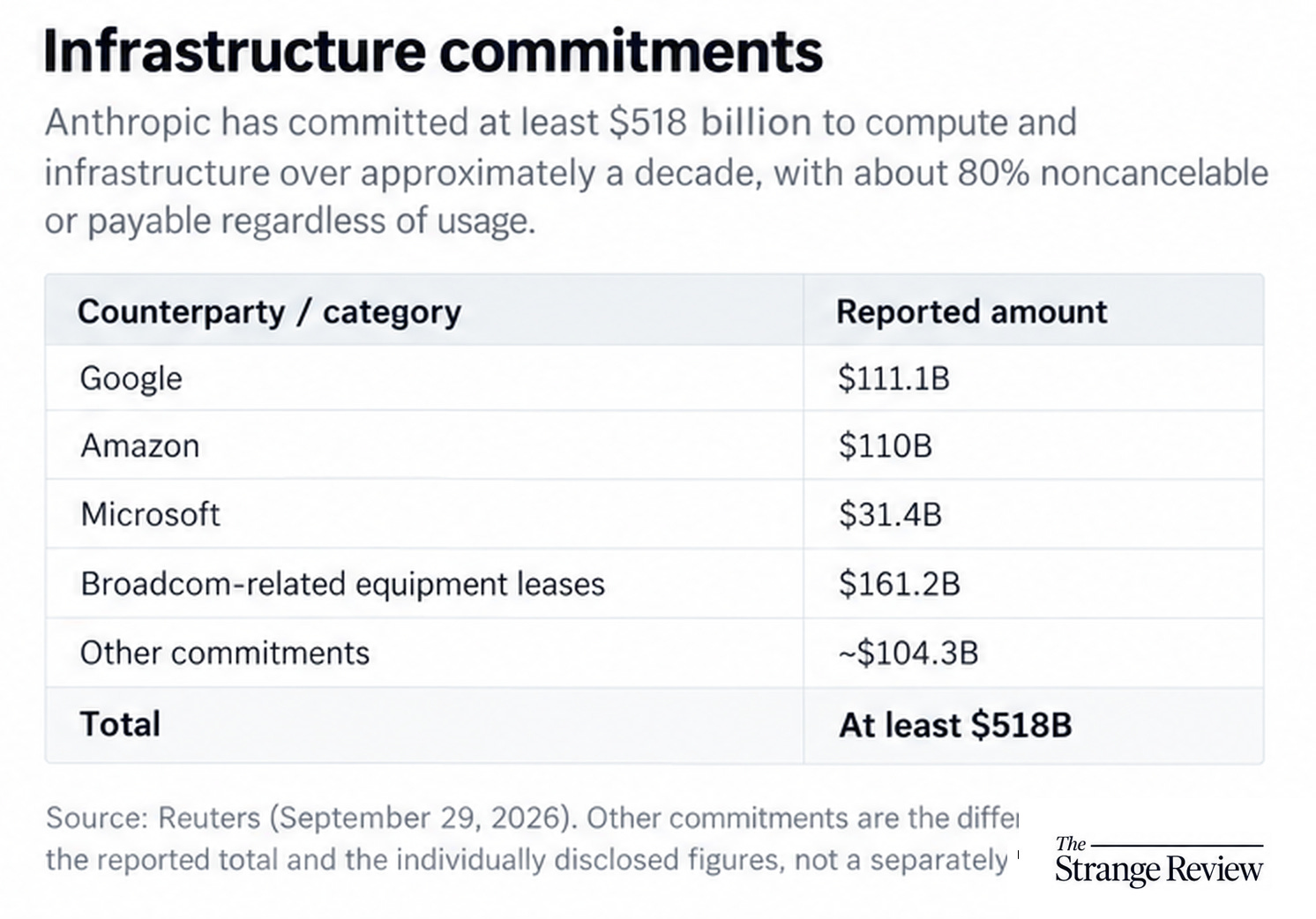
Source: Reuters, September 29.
Anthropic is making commitments that extend seven to ten years into the future, to secure the computing capacity necessary to compete in a market where a model’s technological lead might last only months.
Of course, those commitments support much more than a single model generation. They also secure future capacity, potentially at advantageous prices, for a customer base that is growing extraordinarily quickly.
The infrastructure commitments are long-term. The frontier advantage may not be? This may be where some investors are getting cold feet.
There’s also another layer of risk here around customer / distribution concentration.
Reuters reports that 47% of Anthropic’s 2025 revenue was distributed through Amazon and Google cloud marketplaces. Nearly a quarter of its sales came from just two customers.
Amazon and Google aren’t simply vendors. They’re investors, infrastructure suppliers, distribution channels and, increasingly, competitors, who are developing their own frontier models.
Which brings me back to the finite game.
When I first wrote about it, I was thinking primarily about technological advantage. A model launches, competitors catch up, and the cycle repeats. The question was whether the premium window would be long enough to justify the cost of creating it.
These financials suggest something more nuanced.
Anthropic is demonstrating that frontier AI can generate extraordinary revenue, and that the economics can improve rapidly with scale. That’s meaningful evidence against the simplest version of the bearish thesis.
But we still don’t know whether those improvements can outpace the cost of defending a frontier position indefinitely.
Every generation brings another round of training, infrastructure investment and competition. Meanwhile, the underlying intelligence becomes cheaper and more widely available.
Perhaps the frontier labs become some of the most profitable companies in history. Perhaps the real economic value accrues to the infrastructure and applications built on top of increasingly abundant intelligence. Most likely, there’s room for both.
-Tara
If you enjoy reading The Strange Review and have found it useful, please share it with friends and peers! I’d really appreciate it.
THE DOWNLOAD
China expands its semiconductor manufacturing capacity
China is doubling down on semiconductor manufacturing. SEMI projects that China’s capacity will grow 8.1% annually between 2024 and 2028, compared with 5.3% globally.
Memory offers a striking example. Chinese DRAM manufacturer CXMT is reportedly planning four new fabs or expansion phases through early 2028. If completed, its manufacturing capacity could exceed 600,000 wafers per month, approaching the current capacity of SK hynix and Samsung.
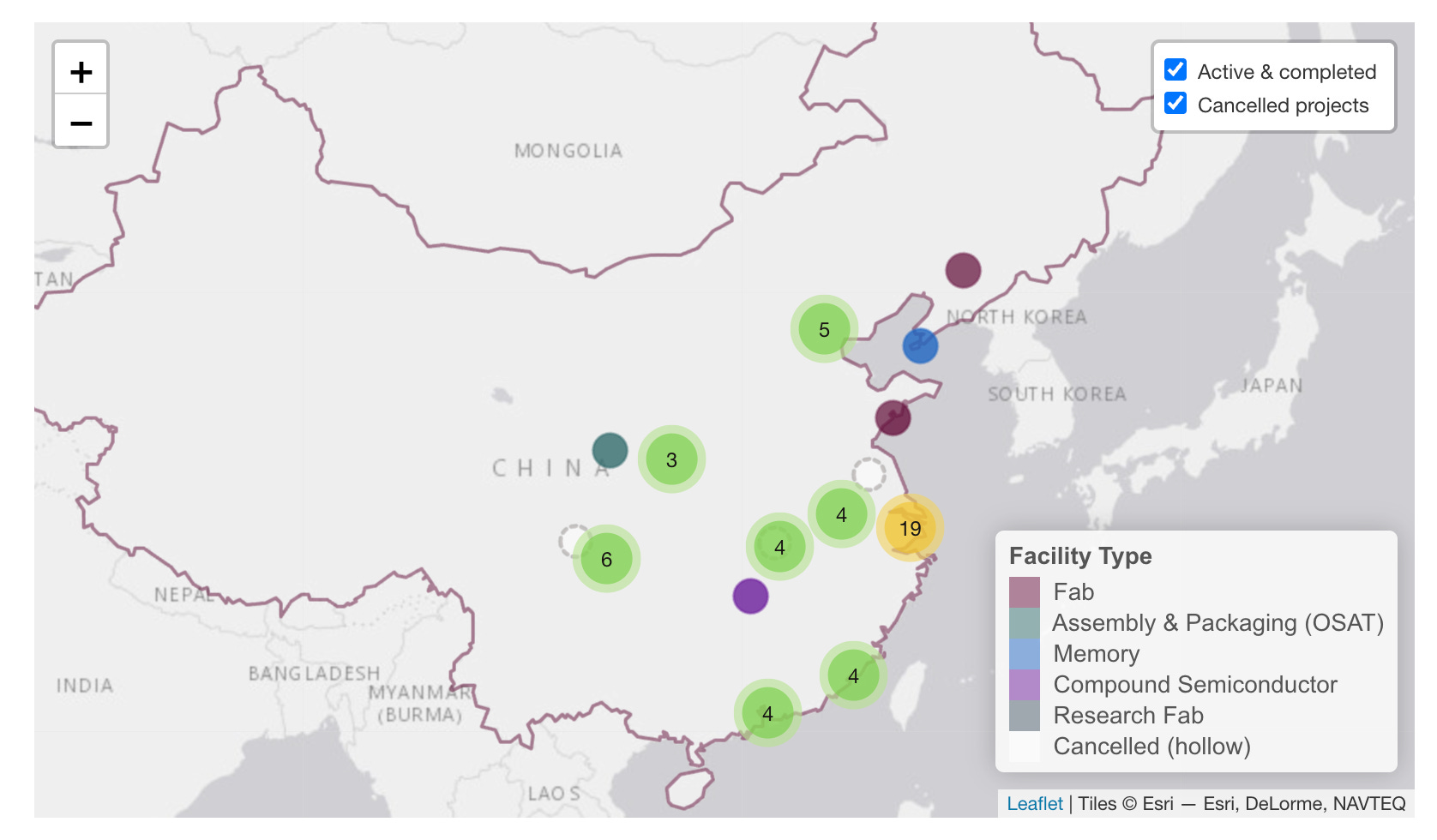
The expansion extends well beyond memory. A new China Semiconductor Tracker maps 57 facilities across 16 provinces and municipalities, spanning logic, memory, packaging and compound semiconductors.
Much of the attention on China’s chip industry focuses on what it still cannot manufacture at the leading edge (e.g. advanced chips). But China is building substantial capacity across the rest of the semiconductor stack. The question is whether this follows a familiar pattern from solar panels and batteries: enormous manufacturing investment, growing domestic capabilities and, eventually, enough capacity to put pressure on global prices.
AI infrastructure debt sells off as borrowing costs rise
AI infrastructure stocks and bonds fell sharply this week, as investors questioned the economics of financing the buildout despite strong demand for computing capacity.
CoreWeave became the focal point. The GPU cloud provider reported approximately $35.6 billion in debt as of June, with quarterly net interest expense reaching $640 million, roughly a quarter of revenue. On Wednesday, yields on some of its unsecured bonds climbed above 15%, while its shares fell sharply. Axios captured the bond-market selloff here.
The immediate pressure came from rising interest rates and renewed scrutiny of CoreWeave’s borrowing. But the underlying concern is more fundamental: companies are financing expensive, rapidly depreciating computing infrastructure with substantial debt, betting that future customer revenue will justify today’s spending.
CoreWeave has approximately $104 billion in contracted revenue backlog, evidence of significant future demand. Yet fulfilling those contracts requires continued investment in chips, data centers and electricity. Higher financing costs can squeeze returns on new capacity even if customers remain committed. The selloff in existing fixed-rate bonds doesn’t immediately increase their interest payments, but it signals what investors may demand when the company needs to borrow again.
The concern extends beyond CoreWeave.
Broadcom CEO Hock Tan warned this week that access to capital could become the industry’s next major bottleneck, as wafer and memory shortages ease.
Tan estimated that companies across the U.S. and China spend roughly $200 billion annually on token generation while only pulling in about $150 billion in revenue, leaving parts of the AI economy financially strained
None of this establishes that AI demand is weakening. It reveals a different constraint: the economics of producing compute depend not only on utilization and hardware costs, but also on how cheaply companies can finance the machines.
Why it matters: AI infrastructure can have extraordinary demand and still struggle to generate attractive returns when the capital required to build it becomes too expensive.
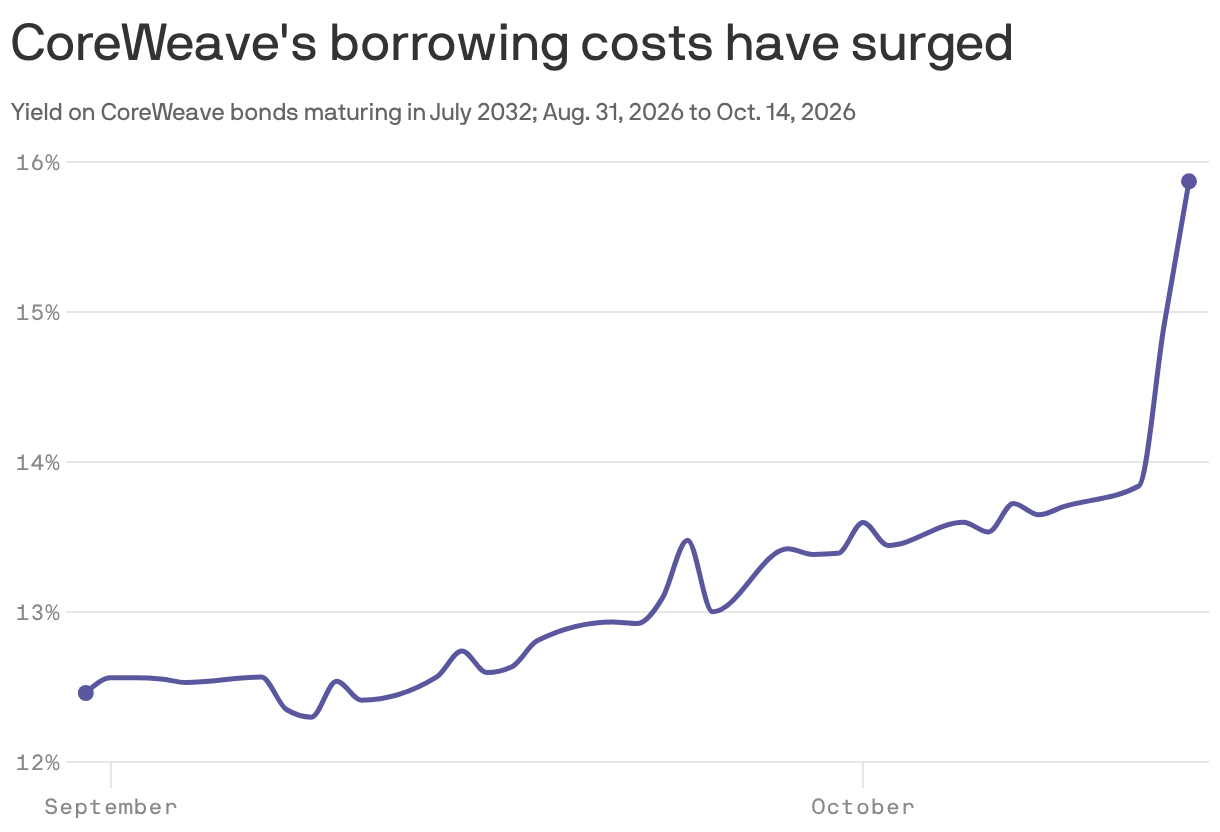
Credit: Axios’s CoreWeave bond-yield chart.
Meta and Google release new frontier AI models
Meta launched Muse Wonder and Wonder Full on Monday, followed by Google’s Gemini 4 Argon on Tuesday. Both releases emphasize a shift toward AI systems capable of carrying out complex tasks over time, rather than simply answering questions.
For Meta, it’s a significant comeback after an expensive overhaul of its AI efforts. The new models introduce Active Memory, which retrieves relevant information across conversations, and Active Focus, which helps agents persist through difficult tasks, recover from errors and try alternative approaches. Muse Wonder is available through Meta’s API, while the more powerful Wonder Full is initially limited to Muse Code subscribers.
Google’s Argon focuses on extended reasoning, coding and professional workflows. It supports a million-token context window, including a long-generation mode designed for sustained tasks. Google is also integrating it into Gemini, Search and its Antigravity development environment.
Memory, tool use, error recovery and sustained execution are becoming increasingly important. And as frontier performance becomes more competitive, distribution matters: Meta has its consumer platforms and Muse; Google has Search, Workspace, Android and Gemini.
The next frontier-model edge in competition may be decided not just by which model is smartest, but how it becomes most useful in people’s everyday work.
Google demonstrates AI agents learning from physical experiments
Google Research published results showing AI agents designing biological molecules, testing them in the laboratory and using experimental feedback to improve subsequent designs.
In one experiment, agents designed DNA aptamers, short molecules that bind to specific proteins. The sequences were synthesized and physically tested before the results were fed back into the next design cycle.
The interesting part was what happened when the experiments failed.
The agents initially optimized for binding strength, producing molecules that appeared promising. But laboratory testing revealed that many were simply sticking indiscriminately to other proteins and experimental surfaces. The confirmed on-target hit rate fell to just 3.7%.
Using that feedback, the agents revised their design rules, filtered out problematic structures and improved the hit rate to 33.5% in the next round. In a separate experiment involving thrombin, hit rates eventually reached 42.1%.
They demonstrate something important about AI-driven scientific discovery. Computational models can generate enormous numbers of promising designs. The harder problem is determining which predictions survive contact with the physical world.
Here, the agents encountered an experimental failure, identified the problem and changed their approach.
Why it matters: AI could become a far more powerful scientific tool when it can learn from the results of physical experiments, not just existing data.
ALSO
Microsoft unveils its next-generation AI inference chip. Maia 300 is designed for long-context reasoning and agentic workloads, with eight HBM4 memory stacks delivering 18 TB/s of peak memory bandwidth. As inference workloads grow, hyperscalers are increasingly designing silicon around their own computing needs.
TSMC explores semiconductor manufacturing in Texas. TSMC confirmed that it is evaluating potential Texas locations and has discussed Elon Musk’s proposed Terafab project. No agreement has been reached, and TSMC insists that any facility manufacturing its chips must be operated by TSMC itself.
A new study suggests conscious perception may depend on timing. In a new preprint, Doris Tsao and collaborators report that neural representations of consciously perceived and suppressed visual information rapidly alternate in the primate brain, roughly 15 times per second. The findings suggest that conscious access may depend on how information is organized over time, not simply where it is represented. The work has not yet been peer-reviewed.
Researchers demonstrate time-crystalline behavior in mechanical materials. A Nature paper describes lattices of actively controlled mechanical components whose oscillations spontaneously organize into coordinated, system-wide motion. The work suggests new ways of engineering collective behavior into physical materials, though practical applications remain speculative.
NVIDIA and Cisco introduce a new optical networking format. The companies announced USFP, a proposed optical transceiver format supporting up to 12.8 Tb/s of bandwidth. They claim four times the bandwidth density of existing 200 Gb/s-per-lane alternatives.
Google backs a 702 MW fuel-cell power project. American Electric Power announced plans for a roughly $4 billion project in Wyoming, supported by a 20-year Google power agreement. The facility will use Bloom Energy’s natural-gas-powered fuel cells, with full operation targeted for 2028.
GlobalFoundries announces two new US semiconductor fabs. Under a US–Japan investment initiative, GlobalFoundries will operate two planned facilities in Malta, New York, backed by up to $21 billion in Japanese investment.
Science Corporation reports early retinal-implant results. Science Corporation says its first Stargardt disease patient, implanted in May, was able to identify a letter and later read a word during rehabilitation.
SK hynix demonstrates a new CXL memory module. SK hynix demonstrated a second-generation 256 GB CXL memory module, claiming more than twice the bandwidth and approximately 30% better energy efficiency than its predecessor.