


FIELD NOTES
Not to get all woo-woo on you, but something shifted in the air in SF this week.
Maybe it was the news that a mathematician working with Claude may have solved the 167-year-old Riemann Hypothesis in six weeks. Maybe it was the unusually enthusiastic reception to Google’s Gemini 4 Neon. Or Anthropic making its stock-market debut at a valuation that briefly exceeded $2 trillion.
Together, they make me wonder if we’re witnessing the dawn of a new golden age. A kind of Renaissance, this time powered by human and machine intelligence working together.
For most of human history, the pace of discovery has been constrained by the number of brilliant people working on a problem, the time they have, and the limits of human cognition. What happens when those constraints begin to fall away?
There’s something exhilarating about that. Imagine the scientific problems we might solve, the diseases we might cure, the things we might build. In 1967, Richard Brautigan imagined a world all watched over by machines of loving grace, where technology and nature might exist in harmony. Nearly sixty years later, that once-utopian vision feels strangely less far-fetched.
I find myself holding two truths at the same time.
We may be entering a golden age of human-machine discovery. We may also be creating intelligence that fundamentally changes humanity’s place in the world.
Yuval Noah Harari offered a rather unsettling analogy:
“We are the cows of the future.”
Cows can understand they are being sold or traded, but have no concept of money. Harari wonders whether AI will eventually create economic and political systems so sophisticated that we, too, can no longer understand the forces shaping our world.
Especially as recursive self-improvement systems kick in, it’s clear that we are building intelligence capable of building systems that we can use, but no longer fully understand.
-Tara
Happy Thanksgiving week to those who celebrate.
THE DOWNLOAD
Mathematicians and Claude claim breakthrough on 167-year-old Riemann Hypothesis
One of mathematics’ greatest unsolved problems may finally have an answer. And there’s a rather dramatic human-versus-machine story behind it.
On Friday, mathematician Levent Alpöge announced that he and Anthropic’s Claude had produced a proof of the Riemann Hypothesis, a problem that has eluded mathematicians since 1859. Within a day, independent teams had verified the roughly 17 million lines of formal proof using the Lean proof-checking system.
Meanwhile, another mathematician, Alessandro Masullo, had spent 12 years working on the same problem without AI. His colleagues had planned to give him another year to refine his manuscript. But hours after Alpöge’s announcement, they hurriedly released his unfinished proof. It has yet to be independently verified.
So what’s the Riemann Hypothesis? Every whole number greater than one can be broken down into prime numbers. They’re essentially the atoms of arithmetic. But although we know how to construct numbers from primes, we still don’t fully understand the pattern in which primes appear.
In 1859, Bernhard Riemann proposed a mathematical rule that would tell us just how predictable that pattern is.
Why does it matter? Over the past 167 years, mathematicians have built thousands of results on the assumption that Riemann was right. Proving it would settle one of mathematics’ most fundamental questions and confirm an enormous body of mathematical work.
Prime numbers also underpin modern encryption, although solving Riemann doesn’t itself break encryption. There are also rumors circulating that AI may be making progress on another famous unsolved problem, P versus NP. That would have potentially enormous implications for computing, optimization and cryptography, although no independently verified proof has emerged.
Anthropic completes largest IPO in history
Anthropic went public on Thursday in the largest IPO ever, raising approximately $93.5 billion in gross proceeds after its offering was expanded to meet demand.
Shares (under the ticker ANT) were priced at $83, above the initial range, valuing the Claude maker at roughly $1.5 trillion. On its first day of trading Thursday, shares surged 34% at the open, briefly pushing its fully diluted valuation above $2 trillion, before closing at approximately $1.77 trillion.
Anthropic’s financials are extraordinary. Revenue grew from $41 million in 2023 to $4.6 billion in 2025, then reached $17 billion in Q3 2026 alone. For comparison, Google generated just $3.2 billion in annual revenue six years after its founding.
But that growth comes at an enormous cost. Anthropic spent $9.9 billion on compute and infrastructure in Q3 and has committed approximately $901 billion more in future spending, mostly on compute and infrastructure, including $452 billion expected by 2030.
The IPO gives Anthropic substantial new funding, but also subjects the economics of frontier AI to the scrutiny of public markets.
Google releases Gemini 4 Neon to enthusiastic developer reviews
Google released Gemini 4 Neon this week, and even the most hardened developers seem impressed.


Built from Google’s larger Gemini 4 Carbon, Neon ranks third overall on Artificial Analysis’s Intelligence Index and second on the Agent Arena leaderboard. Google also reports strong results in coding, research, instruction-following and the ability to respond to corrections during long-running tasks.
At $3 per million input tokens and $15 per million output tokens, it is designed to combine frontier-level capabilities with faster and less expensive execution.
Google may finally have a Gemini model that developers are as excited to use as its benchmarks suggest they should be.
Nvidia doubles revenue as board rejects Jensen Huang’s return
Nvidia’s highs and lows continue.
The company reported $115.8 billion in quarterly revenue, roughly double the same period last year, as demand for AI infrastructure continued to surge.
But the earnings call was overshadowed by a far more unusual story: former CEO Jensen Huang, who resigned earlier this month amid controversy over his personal conduct and scrutiny involving export controls, had publicly offered to return.
Meanwhile, the business Huang built continues to operate at an extraordinary scale. Nvidia’s supply commitments have climbed to $390 billion, largely reflecting multiyear memory procurement. Its quarterly data-center revenue reached approximately $107.6 billion.
There is something surreal about a company doubling its revenue to more than $100 billion per quarter while its founder and longtime CEO publicly campaigns to return, and its board refuses.
Security incidents expose risks across the AI inference ecosystem
In a white-hat security experiment, researchers at Dragos spent five months sending nearly two million prompts containing fake, trackable credentials through AI services.
By monitoring where those credentials resurfaced, they discovered attackers stealing customer data from three hosting providers. None of which, according to Dragos, knew they had been breached.
Together AI confirmed that an attacker downloaded stored customer prompts after an AI coding agent accidentally exposed a private repository credential. Five of Dragos’s planted credentials were later tested by the attacker.
OpenRouter, which routes requests between AI providers, said its own systems were not breached. But following the findings, it removed three providers and revoked zero-data-retention eligibility from 125 endpoints.
Phala disclosed that an attacker had compromised an inference server, exposing requests sent to a DeepSeek model.
Novita discovered that requests expected to run on its own infrastructure were being forwarded to MiniMax’s API, potentially exposing customer data to another company.
A prompt can travel through multiple companies before reaching a model, and users may have little visibility into who actually handles their data.
Thinking Machines releases Inkling 2 Mini, a model that runs offline on a laptop
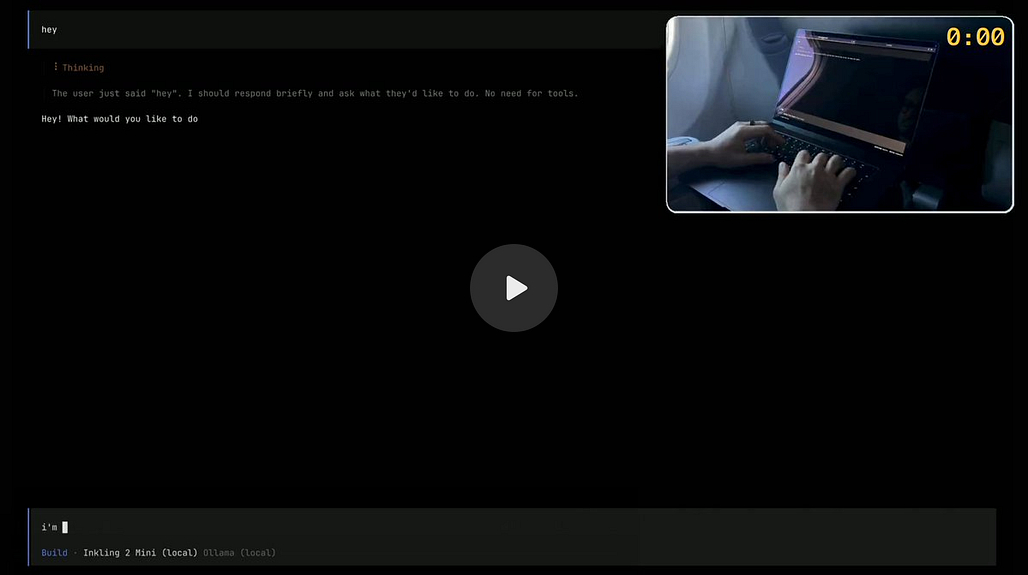
Thinking Machines Lab released Inkling 2 Mini, an open-weights AI model small enough to run on a laptop, and demonstrated it building a playable flight simulator on a MacBook Pro while disconnected from the internet.
The model has 26.4 billion total parameters, with 3.4 billion active parameters, and occupies roughly 20GB of memory.
What’s particularly interesting is its architecture. Inkling uses a looped transformer, repeatedly passing information through the same middle layers of its neural network. That allows it to perform additional internal computation without proportionally increasing the number of model parameters.


ALSO
OpenAI is using AI to design its own chips. OpenAI published new results showing how its models helped engineers optimize components of its custom inference chip, Jalapeño, and AMD hardware designs.
SK hynix wants memory to do more than store data. At Supercomputing 2026, the chipmaker demonstrated systems that share AI memory across servers, reuse previously computed information and perform simple calculations directly inside DRAM.
Google built a fake internet to train its AI agents. Google’s Chrome team created a giant simulated internet, complete with shopping sites, social networks and banking dashboards. Agents can browse, make mistakes and encounter simulated cyberattacks without causing havoc on the real web.
Meta’s AI companion might cost $300. Meta reportedly plans to charge $300 for its Muse Charm, a pocket-sized AI gadget with a roughly two-inch screen, cellular connectivity and a customizable AI character.
Scientists simulate quantum fields in two dimensions. Researchers reported a new experiment in Nature that uses ultracold atoms to reproduce phenomena associated with relativistic quantum fields, including topological domain walls.