


FIELD NOTES
We talk about AI like the hard problem is reasoning or tool use, but the thing that actually makes something truly useful is context and continuity. They remember what you said last time. They update without being asked.
I think a lot about how to program agency into the agents I’m building. Is it more tactical like setting up chron jobs for pings, reminders, or workflows? Is it more systematic like building self-improvement loops with eval agents and PM agents set up to gather feedback, success metrics, and propose new features? You probably need some version that combines both modes.
My kids have started picking up chess in the last few months. And it’s really interesting watching them build fluency in two modes of thinking. When they play logic-based games on the iPad, they speed through fast feedback, practice reactive thinking, instant pattern matching. When they play chess on the board, it’s much slower, more strategic. You sit with a position. You think about what happens if you do nothing.
I think fluency in both modes of thinking - the fast reactive one and the slow strategic one - is the thing to build muscle in the next era. For founders building and improving these systems, and for the five-year-old staring at a board right now trying to decide whether to move his knight.
— Tara
THE DOWNLOAD
SpaceX Signs $920M Monthly Compute Deal with Google Through 2029
SpaceX disclosed in an SEC filing that Google will pay $920 million per month from October 2026 through June 2029 for access to roughly 110,000 NVIDIA GPUs, CPUs, and memory at data centers inherited from xAI, which SpaceX absorbed in an all-stock merger earlier this year. The deal totals approximately $30-32 billion over its life. It follows a late-May arrangement in which Anthropic committed $1.25 billion per month for all available compute from SpaceX’s Colossus 1 facility near Memphis.
Why it matters: Combined with the Anthropic deal, SpaceX is now on track for roughly $2.17 billion per month in AI compute revenue, an annualized run rate of ~$26 billion. That would make it one of the largest GPU lessors on the planet. Google, one of the world’s largest owners of AI infrastructure, called this “bridge capacity” for surging Gemini Enterprise demand it cannot meet with its own data centers. The disclosure lands one week before SpaceX’s June 12 Nasdaq debut, converting what looked like an xAI cost center into a concrete, multiyear recurring revenue stream.
Anthropic Publishes Internal Data on AI Automating Its Own Development And Calls For Global Pause (Again)
Anthropic’s research arm published “When AI Builds Itself,” disclosing that over 80% of code merged into its codebase is now written by Claude, and that its engineers ship roughly 8x as much code per quarter as they did from 2021-2025. The company said Claude’s success rate on open-ended engineering problems reached 76% in May 2026, up 50 percentage points in six months, and that Claude-written code quality is now roughly at parity with human-written code at Anthropic.
Why it matters: This is the first time a frontier lab has published hard internal metrics on how much of its own development loop is automated. Anthropic framed the trajectory as pointing toward “recursive self-improvement,” where AI systems design their own successors, and called for the option to pause frontier development globally.
NVIDIA Launches Cosmos 3 Open Foundation Model for Physical AI
NVIDIA released Cosmos 3 at GTC Taipei, an open model built on a mixture-of-transformers architecture that unifies vision reasoning, world simulation, and action generation in a single system. It was trained on 20 trillion tokens of multimodal data including action data from humans and robots. Available on Hugging Face in Nano (8B, runs on workstation GPUs) and Super (requires Hopper/Blackwell) variants.
Why it matters: Physical AI teams currently stitch together separate vision, simulation, and policy models. Cosmos 3 collapses those into one. The open release, with a Cosmos Coalition including Skild AI, Runway, and Black Forest Labs, extends NVIDIA’s platform strategy beyond silicon into the model layer for robotics and autonomous systems.
OpenAI Rolls Out Dreaming V3 Memory Architecture for ChatGPT
OpenAI launched Dreaming V3 on June 4, replacing ChatGPT’s manually saved memory list with a background synthesis process that continuously reads across past conversations and updates what the system knows about a user. Memories now self-update over time and are stored in a separate data layer injected at inference.
Why it matters: Persistent, self-updating memory turns a stateless chatbot into something closer to an ongoing relationship, which is the retention mechanic consumer AI products need. OpenAI’s internal evals show factual recall rising from 41.5% to 82.8% between the 2024 and 2026 memory systems. The privacy concerns expands significantly: memories are now synthesized without explicit user action, and the audit trail is less transparent than a simple saved-facts list.
MIT Publishes Categorical Framework for Self-Evolving AI Scientists
MIT researchers Buehler and Wang published a framework (arXiv:2606.01444) for AI systems that can expand their own scientific reasoning schemas, moving from search within a fixed vocabulary to genuine discovery of new concepts. Case studies demonstrated the approach in protein mechanics and fiber-network materials, using category theory to formally verify that the system’s schema actually expanded.
Why it matters: Most AI science tools search a space humans defined. This framework formally distinguishes between retrieval, search, and discovery, and provides a mathematical proof that the system entered a new reasoning regime. If the approach generalizes, it changes how autonomous labs are built: the system doesn’t just run experiments faster, it redefines what experiments are worth running.
Stephen Wolfram Applies Computational Ruliology to Game Theory
Wolfram published a research essay systematically exploring what happens when programs compete in iterated games. Rather than studying individual strategies, the piece exhaustively enumerates all possible strategies as finite state machines, cellular automata, and Turing machines, then ranks them. The central question: does competition tend to produce complexity or simplicity in winning strategies?
Why it matters: The framing is directly relevant to autonomous agent competition. As AI agents increasingly interact in markets, negotiations, and resource allocation, the structure of winning strategies matters. Wolfram’s earlier work on biological evolution and machine learning found that simple programs can produce complex behavior; now it asks whether adversarial pressure changes that dynamic.
SemiAnalysis Roundup: Post-Copper Interconnects, CFET Progress, and SK Hynix V9 NAND
SemiAnalysis published its IEDM 2025 deep dive, covering ruthenium and molybdenum interconnects as copper hits scaling limits, SK Hynix’s 321-layer 3D NAND with 5-bit-per-cell architecture, and progress toward 1,000 CFET transistors and 2D channel materials.
Why it matters: The interconnect transition from copper to ruthenium at the tightest metal layers, potentially as soon as the 14Å node, will reshape equipment and materials supply chains. SK Hynix’s 5-bit-per-cell NAND directly addresses the capacity crunch driven by AI datacenter demand. These are the physical-layer bets that determine whether Moore’s Law keeps delivering for AI scaling.
EVENTS
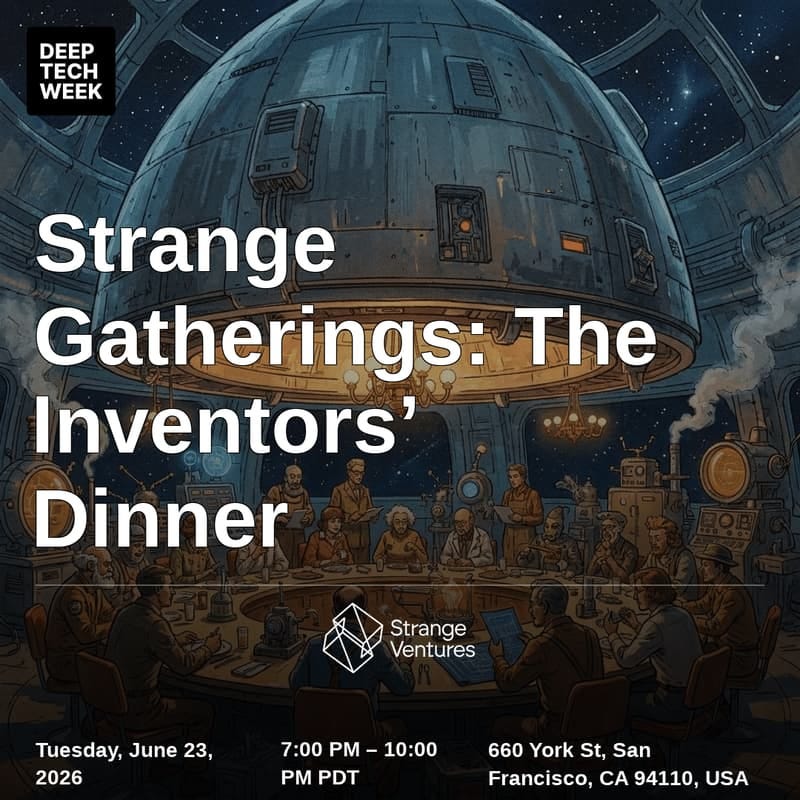
Strange Ventures is hosting a private dinner for a small group of scientists , researchers, and founders at SF Deep Tech Week.
We’ll gather around a Jeffersonian table to discuss the breakthroughs, discoveries, and ideas that may shape the next decade.