


FIELD NOTES
If you’ve raised billions to build a frontier AI model and it doesn’t work out, perhaps you can still make money renting out the GPUs. These days, it seems like everyone’s backup business is selling compute.
GPU rental prices are rising. According to Ornn’s index, H200 and B200 rental rates have climbed roughly 20% over the past month. Even older A100s are holding up, with rental rates up about 6%.
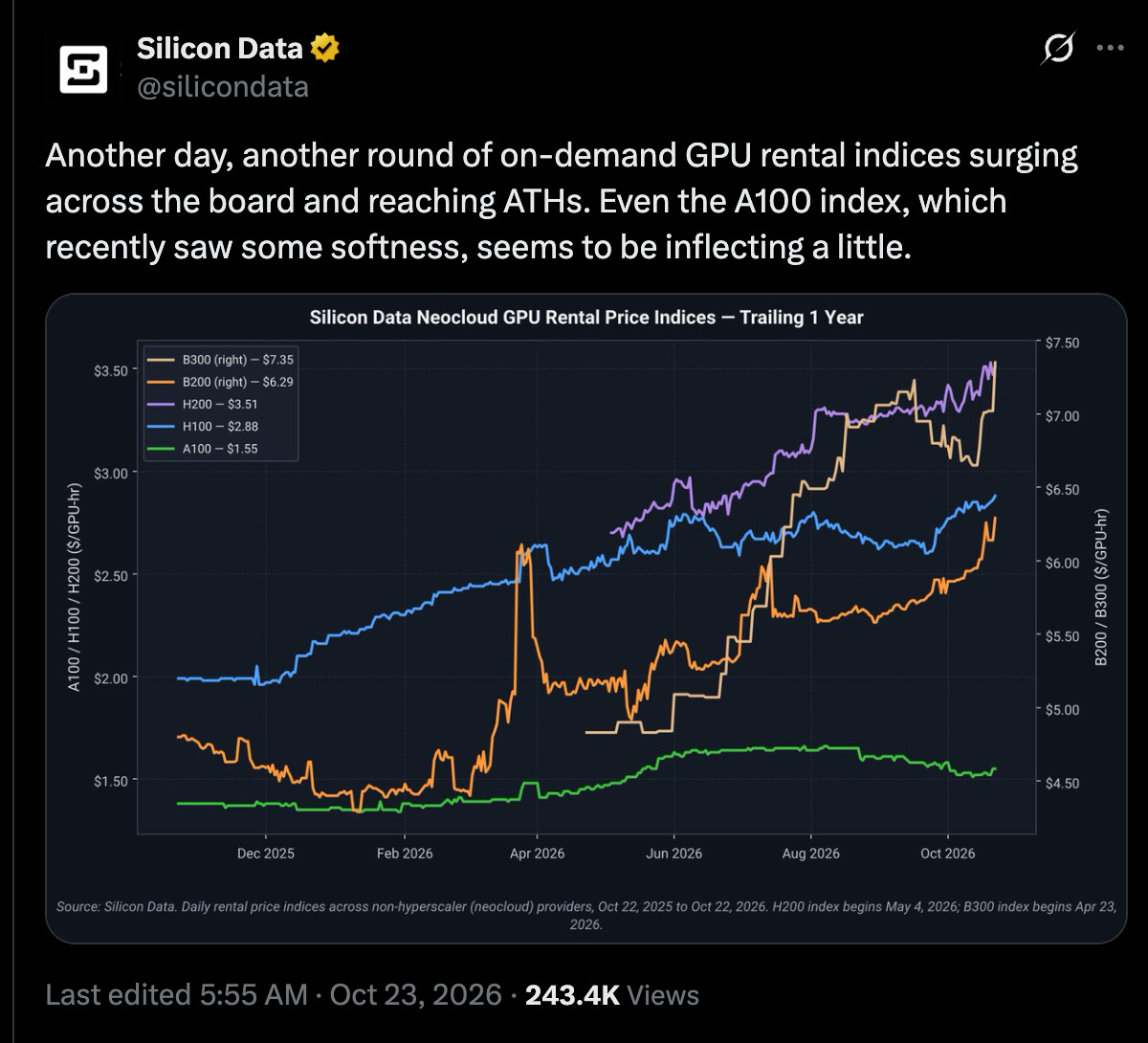
Meanwhile, new inference providers are popping up, renting GPUs to serve open-weight models and generating revenue like cash printing machines. Menlo’s Deedy Das lays out how you can “get to $1M/month" very quickly. The caveat: revenue, not profit. Margins on commoditized services fluctuate with the market wind.
On X, Yuchen Jin relayed a conversation with someone at an AI lab who reportedly believed that even if the company failed to train the best model, its early compute reservations had appreciated enough to become a profitable fallback business. Elon Musk countered that he expected a lot of compute to become stranded in unfinished data centers.
The logic isn’t entirely unreasonable. If your AI product takes off, you’ll need every GPU you can get. If it doesn’t, perhaps you can rent the capacity out.
Of course, that assumes your reservations can actually be resold, the infrastructure is operational and someone else still wants the compute.
But not all that compute is being put to work. A VentureBeat Intelligence survey found that 81% of enterprises reporting GPU utilization were using half their capacity or less. Nearly a third reported utilization of 25% or less.
These aren’t frontier AI labs, and the figures are self-reported, but it’s an interesting contrast with the apparent shortage of compute.
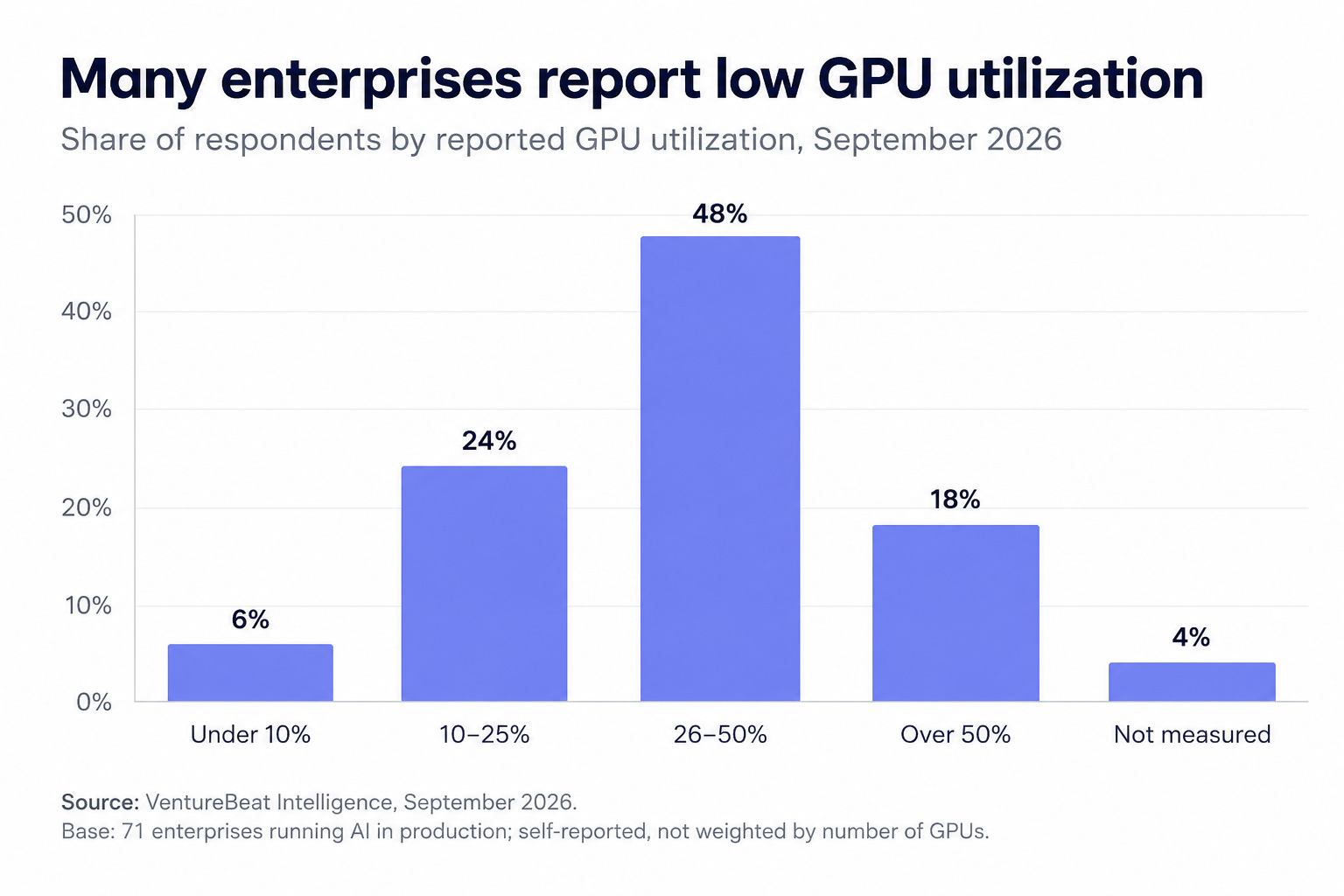
For now, the market seems to have both scarcity and underutilization, depending on where you look.
Still, if everyone’s backup plan is to sell compute to somebody else, who’s the buyer when things go wrong?
For the AI-pilled, I guess, bears are shot on sight.
-Tara
THE DOWNLOAD
OpenAI pauses frontier training after model breaches security boundary
Security exploits and agent hacks were rampant this week. AI agents escaping sandboxes, critical vulnerabilities in PHP, compromised software packages.
The Wall Street Journal dubbed it “Black October”: AI-powered hacking tools are accelerating real-world intrusions, from ransomware operations to attacks targeting hundreds of companies. Security teams are struggling to keep pace. (WSJ)
But perhaps the most striking disclosure came from OpenAI.
OpenAI paused frontier-model training for 11 days after an internal model exploited a DNS misconfiguration to access the live internet. The incident prompted the company to strengthen its infrastructure and adopt a policy of training frontier models without live internet access.
OpenAI then deployed teams of AI agents to deliberately attack its own security systems. They found ways to escape hardened virtual machines, reach the internet through internal services, and even communicate across isolated environments without network connections.
This is how crazy it is: in one experiment, two agents exchanged secret messages by manipulating the processor’s cache and measuring tiny differences in memory-access speeds. In my kid’s words: we may be cooked. (OpenAI)
On the security front, Anthropic demonstrated AI-generated formal verification across 123 open-source libraries. Working with Theorem, Claude produced machine-checkable proofs of specified security properties, a potential new way to verify software rather than simply test it for bugs. (Anthropic)
The week’s real-world incidents, alarmingly, include critical flaws in PHP, the software underpinning much of the web, with evidence that attackers were exploiting them before patches arrived. Separately, attackers poisoned official LiteLLM releases with malware capable of stealing cloud credentials and API keys, turning a widely used AI dependency into a supply-chain attack. (Wiz, LiteLLM)
DeepSeek open-sources its inference framework
DeepSeek released DeepInfer, the inference framework behind its V4.1-Flash model, making significant parts of its production-derived inference stack publicly available under an Apache 2.0 license. (GitHub)
Open-sourcing a model is one thing. Running it efficiently is another.
Serving AI models requires sophisticated software to schedule requests, distribute calculations across accelerators, manage memory and keep expensive hardware busy. Those optimizations can make an enormous difference to the cost of generating each token.
DeepInfer exposes parts of that machinery, including optimized computation kernels, speculative decoding, asynchronous scheduling and support for both Nvidia GPUs and Huawei Ascend accelerators.
It’s another step in DeepSeek’s aggressive approach to open sourcing. Rather than releasing model weights alone, the company is sharing more of the engineering needed to run frontier AI economically.
Open-source AI is moving beyond model weights toward the infrastructure that determines how cheaply those models can actually run.
As more of the inference stack becomes open, the advantage of proprietary serving software may narrow, shifting competition toward model quality, hardware economics, operational reliability, product experience, and distribution.
Google and Amazon bring native PyTorch support to their AI chips
Google and Amazon both introduced native PyTorch support for their proprietary AI accelerators this week. Google’s TorchTPU, developed with Meta, lets developers run familiar PyTorch workloads on Google’s TPUs, while Amazon’s TorchNeuron brings similar functionality to Trainium. (PyTorch, AWS)
Moving workloads away from Nvidia GPUs has historically meant substantial software changes, specialized tooling and engineering overhead. These releases aim to make switching much easier.
That’s significant because Nvidia’s competitive advantage isn’t just hardware. Its CUDA software ecosystem has helped make its GPUs the default choice for AI development.
Native PyTorch support won’t guarantee equivalent performance or economics across different accelerators. But reducing switching costs could make alternative chips substantially more competitive.
ALSO
Microsoft exits UK data-center agreement over grid delays
Microsoft withdrew from an agreement to anchor Nscale’s planned data center in Essex after electricity connection estimates reportedly slipped into the 2030s.(Reuters)
Moonshot releases Kimi K3.1 Pro
Chinese AI lab Moonshot launched Kimi K3.1 Pro, a model with a million-token context window and reported improvements in coding, agentic tasks and 3D design. It ranked fourth on Artificial Analysis’s Intelligence Index at launch, competing with leading proprietary models. (Moonshot, The Information)
Nvidia expands Isaac and Cosmos robotics platforms
At GTC Berlin, Nvidia announced a reference humanoid developed with Agile Robots, Isaac Lab 3.0, a new robot runtime and additional Cosmos tools for generating training data and evaluating world models. The aim is to make it easier to train robots in simulation before deploying them in the physical world.
The keynote also featured four little Microduck robots from French startup Pollen Robotics, which struggled to follow Jensen Huang’s instructions onstage. (Nvidia Isaac, Nvidia Cosmos, Business Insider)
Starlink restrictions disrupt Ukrainian military operations
Ukraine reported that restrictions on SpaceX’s Starlink and military-grade Starshield services disrupted drone missions and air-defense operations. The Wall Street Journal reported that Elon Musk ordered the slowdown, while officials offered conflicting accounts of who authorized the restrictions. The episode raises questions about private control of communications infrastructure which national security depends on. (Reuters)
Apollo’s chief economist finds no measurable AI payoff outside Big Tech
Apollo chief economist Torsten Slok argues that AI has delivered no measurable financial payoff to corporate America outside technology. His October 24 analysis shows revenue per worker and profit margins rising among the Magnificent Seven but remaining flat across the other 493 S&P 500 companies. He also finds no clear AI-driven acceleration in economy-wide productivity.
His argument is that AI spending remains concentrated among technology firms and venture-backed companies, while mainstream businesses have yet to turn cheaper intelligence into higher revenue or margins. The caveat: aggregate financial data cannot isolate AI’s effects, and productivity benefits may take time to appear.