FIELD NOTES
The world's largest hedge fund gave frontier models a single job: read the day's financial documents and flag what matters. With prompts written by Bridgewater's own investors, the best frontier models couldn't clear 80 percent accuracy. A model Bridgewater fine-tuned on Qwen (an open source model), with Mira Murati's Thinking Machines, cleared the bar at a fraction of the inference cost.
This gets at the question I've been chewing on all week: do we need better models, or better systems around the models?
Big bids for custom models have entered the arena this week. Palantir’s Alex Karp went for drama on CNBC this week where he chewed out OpenAI and Anthropic for converging into “commodity cognition”.

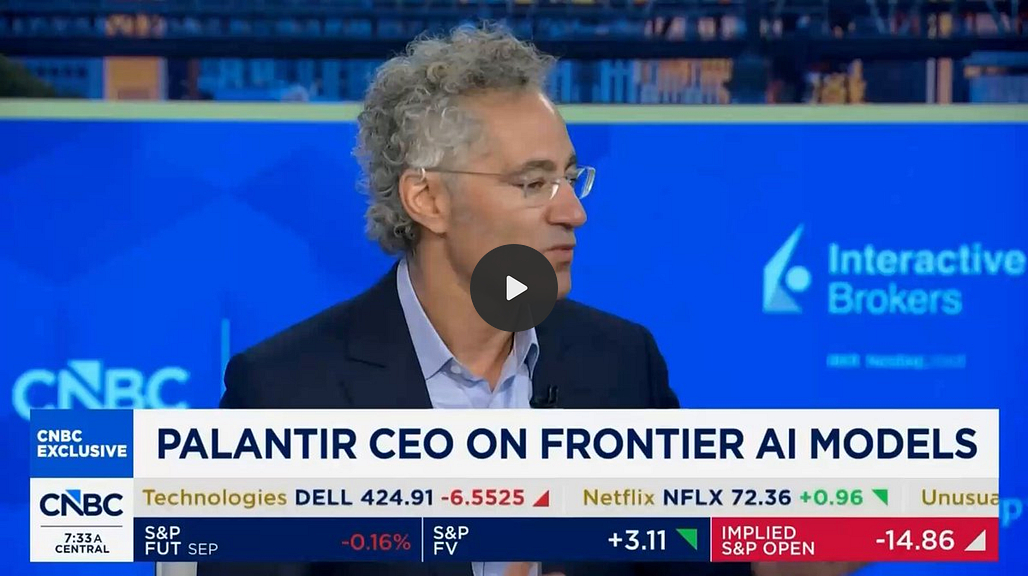
(And yes obviously they are hawking the problem to the solution, with an announced partnership with Nvidia on Nemotron to run custom open-weight models. )
The industry seems fairly split on this. On one hand, there’s a largely unspoken worry about using foreign LLMs, even if it’s open source.


On the other, frontier token costs are really, really expensive relative to open models. And the bet is that custom open models, fine-tuned to your needs and data, will outperform.

Anecdotally, I think both fears are real. In my conversations with AI executives at large corporations, I’m finding that the honest answer right now is more around usage maturity. AI usage at isn’t high or sophisticated enough yet to be prohibitively expensive or warrant switching to custom models (unless it outperforms).
Bridgewater’s result worked because the fund had a high-value task, senior experts whose judgment was worth encoding, and the evaluation infrastructure to know when the model had actually absorbed it. Most enterprises have none of those yet, which is why they buy tokens.
The challengers have entered the arena. The question is how many buyers are ready to meet them there.
Hope you had a great 4th! Enjoy the update.
-Tara
THE DOWNLOAD
Meta Building Cloud Business to Sell Excess AI Compute
Meta is developing a cloud business, internally called Meta Compute, to sell surplus GPU capacity and hosted access to its closed-weight Muse Spark models, competing with AWS, Azure, and Google Cloud. The move follows SpaceX/xAI leasing Colossus capacity to Anthropic (reportedly $1.25 billion a month) and Google, and aims to recoup Meta’s $182.9 billion in AI infrastructure commitments. Meta shares rose roughly 9%; CoreWeave and Nebius fell about 12% each.
Why it matters: The market read this correctly, and the losers are the neoclouds, not the hyperscalers. Meta is a major customer of CoreWeave and Nebius; if it can serve its own excess capacity, it may not need theirs. The deeper signal is that a company that spent $183 billion chasing superintelligence is now building a fallback that monetizes the infrastructure regardless of whether its own models win.
Unitree Robotics Wins Approval for $619M Shanghai IPO
China’s securities regulator approved Unitree’s STAR Market listing on July 3, clearing the humanoid and quadruped maker to raise 4.2 billion yuan ($619 million) at a valuation near 42 billion yuan. Unitree is rare among robotics firms in being profitable, reporting 1.7 billion yuan in 2025 revenue and 591 million yuan in adjusted profit, and shipped more than 5,500 humanoids last year, first worldwide by volume.
Why it matters: This is mainland China’s first major humanoid listing, and it hands the sector a public-market benchmark at a moment when Chinese embodied-AI funding has hit records of roughly $10.8 billion in 2025 and exceeded $2.9 billion in the first two months of 2026 alone
OpenAI Floats 5% Equity Stake for US Government
OpenAI has held early-stage talks about giving the US government a roughly 5% stake, worth about $42.6 billion at its $852 billion valuation, via a vehicle modeled on the Alaska Permanent Fund. Altman first raised the idea in early 2025 and has pitched a version in which every leading US lab contributes 5%.
Why it matters: The proposal surfaced days after OpenAI delayed GPT-5.6’s launch at the government’s request, and it sits between unfettered private ownership and Senator Sanders’s push for 50%. A voluntary equity giveaway from a company still years from IPO is a novel way to buy political goodwill, and if it sets precedent, foreign governments will demand the same, complicating every cross-border deployment.
Anthropic Restores Fable and Mythos After Export Controls Lifted
The US Commerce Department lifted export controls on Claude Fable 5 and Mythos 5 on June 30, ending a roughly two-week shutdown. Fable 5 returned globally July 1; Mythos 5 came back only for a set of approved US organizations. The freeze began June 12 after Amazon researchers demonstrated a jailbreak; Anthropic pulled both models from every cloud platform because it couldn’t verify user nationality in real time. Anthropic will now pre-release frontier models for federal review.
Why it matters: Mythos 5’s phased return through Anthropic’s Glasswing program establishes a trusted-partner tier sitting between full public access and total suspension. The pre-release review commitment also raises the question of whether Washington now effectively approves every frontier launch.
Microsoft Launches $2.5B Frontier Company for Enterprise AI
Microsoft created Microsoft Frontier Company, a $2.5 billion unit embedding 6,000 engineers inside customers like Unilever, Novo Nordisk, and LSEG to integrate AI, including rivals’ models, with proprietary data, and customers keep the resulting IP. It arrives days after AWS committed $1 billion to a similar embedded-engineering unit and after OpenAI’s $4 billion-backed Deployment Company.
Why it matters: Every major AI vendor has stood up the same forward-deployed model within eight weeks, all aimed at one number: roughly 95% of enterprise AI pilots deliver no measurable result. The battleground is shifting from who builds the biggest model to who can make deployment stick inside a customer’s operations.
Bending Spoons Surges 40% in Nasdaq Debut
Bending Spoons, the Milan firm that acquires and revives legacy software like AOL, Evernote, Vimeo, and WeTransfer, closed up nearly 40% on July 1 at a $25.7 billion market cap, more than double its last private valuation. Revenue grew from $387 million in 2023 to $1.31 billion in 2025, and it swung to a $27.5 million quarterly profit. The company carries roughly $4.4 billion in debt and has flagged 1,000-plus acquisition targets.
Why it matters: A debt-funded acquire-and-fix operator popping 40% in a year investors feared AI would gut traditional SaaS is a real signal about where public appetite sits. Bending Spoons explicitly marketed itself as AI-native (”AI before it was cool”), and buyers rewarded the framing.
AI Designs Radio Chips That Outperform Human Layouts
Princeton researchers used reinforcement learning, inverse design, and diffusion models to generate RFIC layouts that beat human-designed circuits on bandwidth, power, and efficiency while cutting design time from weeks to minutes. The AI-produced structures look “more like a QR code” than conventional symmetric layouts, unconstrained by human templates.
Why it matters: RF chip design has stayed a hand-crafted “dark art” even as CPUs and GPUs went algorithmic, so this is a genuine unlock in one of the last manual corners of semiconductor design. Compressing years of iteration into minutes changes the economics of building custom RF silicon for 5G/6G, autonomous vehicles, and satellite links.
Anthropic Launches Claude Science Workbench
Anthropic launched Claude Science on July 1, a research workbench connecting 60-plus scientific databases with prebuilt genomics, proteomics, and chemistry toolkits, a reviewer agent that checks citations, and full provenance on every figure. It runs on existing Claude models with no new capabilities and no gating, available in beta to all paid subscribers. It contrasts with OpenAI’s gated GPT-Rosalind and Google’s proprietary Gemini for Science.
Why it matters: The bet here is that what slows science isn’t raw model capability but the friction of stitching together dozens of databases and tools, so Anthropic is competing on workflow ownership rather than a specialized model, the same move that made Claude Code sticky. The three labs have now split into distinct strategies: Anthropic on broad access plus a workflow layer, OpenAI on a governed specialist model, Google on proprietary foundation models.
Kioxia Ships 332-Layer Flash Samples for AI Data Centers
Japanese memory maker Kioxia began sampling its 10th-generation 332-layer 3D NAND on July 2, offering 59% higher bit density and a 33% faster interface than its 8th-generation chips, aimed at enterprise and data center SSDs. Kioxia holds roughly 10% of the data center flash market against Samsung’s 40% and SK Hynix’s 30%; shares rose 8.9% after swinging double digits.
Why it matters: The timing matters more than the density gain. This lands with AI flash supply tight and Kioxia’s 2026 output largely sold out, and an Omdia analyst argues its NAND speed is the metric US hyperscalers weigh most. But sampling is not volume: operators typically evaluate for months before ordering, and mass production isn’t slated until 2027, so this is a claim on share, not a shift in supply. Kioxia’s stock, up more than 680% this year, is now priced on the assumption memory tightness holds.
Google Reports 37% Jump in Electricity Use Driven by AI
Google’s 11th environmental report, released June 30, showed a 37% year-over-year rise in electricity demand, its largest ever, pushing total use up more than 250% since 2019. The company matched 100% of consumption with renewable purchases and cut operational emissions 2%, but supply-chain emissions rose 25%, with data center construction alone adding 2.3 million tons of CO2. Google states plainly that its AI buildout is outpacing grid decarbonization.
Why it matters: Operational emissions are addressable with power-purchase agreements. Scope 3, embedded in chips, HBM, steel, and construction across grids in Taiwan, Japan, Vietnam, and India, is not. Every hyperscaler scaling AI compute inherits the same split, and it reframes the energy question from how much clean power a company contracts to where and when its data centers actually draw, and what its supply chain burns to build them.
EVENTS
Join us for cold beer and Hot Chips in the Fall! August 24 @ 530pm in Palo Alto