


Apple’s AI strategy is starting to come into focus: make the computers people already own a more capable place to run intelligence.
A new leak about Harbor suggests Apple is testing software under its Claris brand that turns Macs into private AI servers. The reported promise is to make it easy to connect machines into a cluster and load a model, without the command-line setup. While Apple hasn’t confirmed it, they have been gesturing towards this direction over the past several months.


On August 25, while announcing the new Mac Studio, Apple explicitly pitched local AI “without counting tokens or worrying about rising cloud costs.” Teams could connect several Studios over Thunderbolt 5 to run the largest open-weight models.
And then on October 15, Apple’s machine learning team demonstrated four Mac Studios running an 816-billion-parameter model at over 36 tokens per second.
Harbor, if accurately described, would make that capability easier to use. A small team (a solo operator to businesses) could run a shared model on machines it owns. Sensitive work could stay within its own environment. And Apple could sell the hardware regardless of who developed the model.
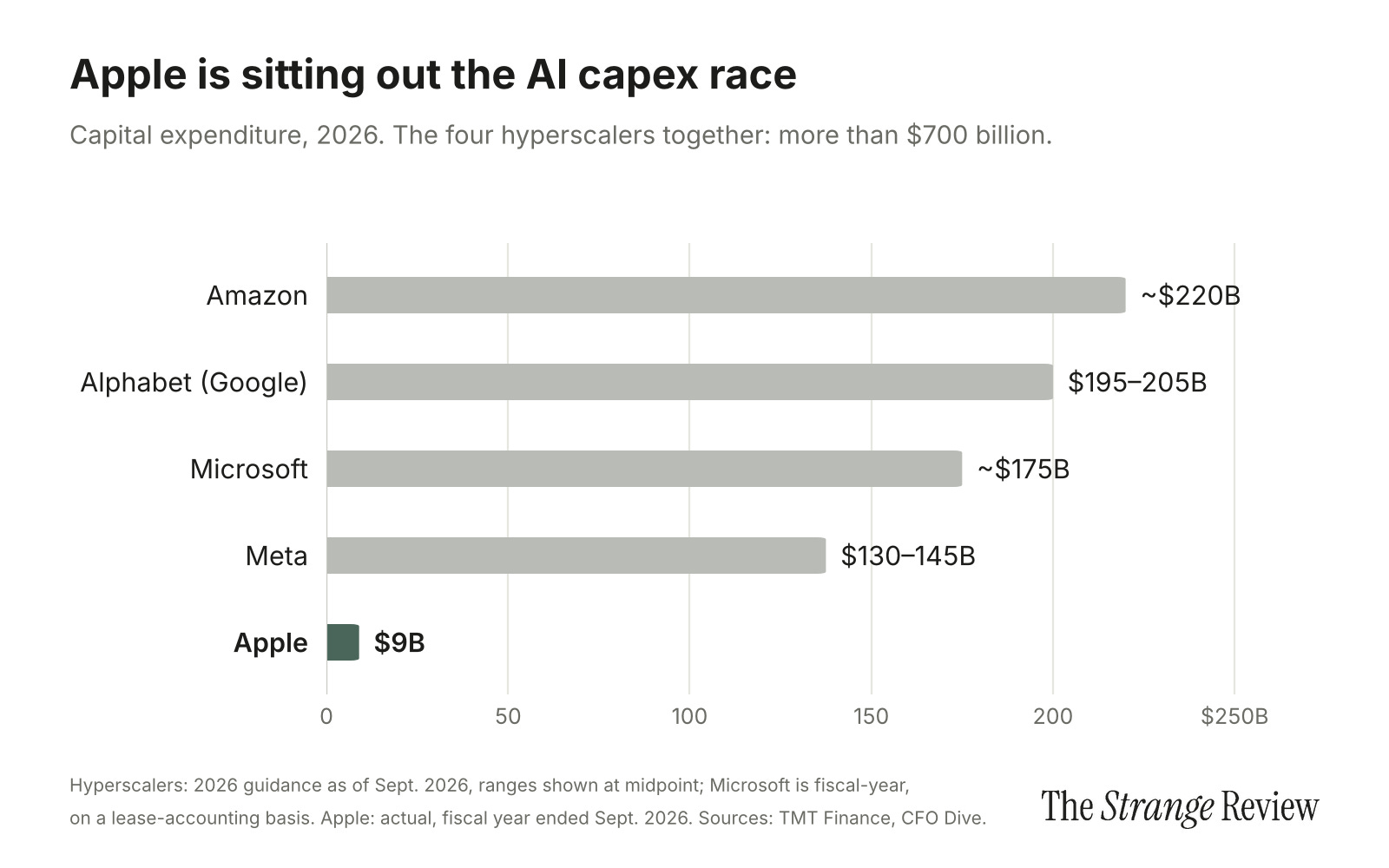
That approach sits alongside a striking difference against the other hyperscalers. In contrast, Alphabet, Amazon, Meta and Microsoft have collectively moved towards more than $700 billion in capital expenditure for 2026. Apple’s capital spending fell 29% to $9 billion in fiscal 2026.
The gap shows how differently Apple is committing capital to AI infra. Their bet instead might be to make more intelligence useful on the customer’s own hardware. It faces shockingly little competition at that scale.
Agents are going multi-computer too
Models aren’t the only thing spreading across machines. Agents are, too.
This week, OpenAI’s pash highlighted a new feature called “multi-exec” that rolled out to (their always-on agents) Dots, that lets an agent work across computers its owner connects. He described an agent building and testing an iPhone app on the Mac Studio sitting on his desk. It worked in Xcode and sent screenshots as it went.
So why give a cloud agent another Mac mini when the agent already has a cloud computer?
The Mac Mini has something the model needed: access to an established working environment. In this case, the iOS ecosystem.
Xcode is one example. There’s also iMessages. Notes. Calendars. Photos. Documents. The applications you’ve configured and the projects you’re halfway through. And now even the power house apps like Adobe’s Creative Suite have joined the bandwagon. Just yesterday, on November 10, it previewed local MCP integrations that will let third-party agents like Codex or Claude work through Photoshop, Illustrator, Premiere and After Effects on your computer.
Apple has long made on-device processing central to its privacy architecture, while using Private Cloud Compute for more demanding requests. That gives it a foundation that makes it more compelling for agentic work and actions that need permissions.
Apple’s last-mile bet
My hypothesis is that Apple sees the last mile of AI as an on-device business.
The models may come from several suppliers. Some reasoning may happen in a datacenter. But personal context, permission to act and an increasing share of inference can live on hardware the user controls.
Harbor, along with agent systems and MCP integrations suggest a larger role for the personal computer as AI becomes capable of doing sustained work.
The question is whether Apple can make this easy and dependable enough to matter beyond enthusiasts. A cluster benchmark is one thing. An agent that works across your apps, respects permissions and leaves you in control is another.
That is what would make Apple a dark horse: turning better models from across the industry into a stronger reason to own many more of its devices.
Today, you buy a Mac for yourself. The next one might be for your agents. And if running local intelligence becomes easy enough or if you manage a fleet of agents, you might buy them a cluster.
Happy Veterans Day!