


The talk of the town last week was software rollup shop Bending Spoons’ acquisition of Airtable, in a deal that values the company at roughly $2.25B, about an ~80% haircut from its $11.7B peak in 2021.
The easy explanation is that Airtable was a casualty of ZIRP-era hype.
But here’s the strange thing: Airtable actually grew.
At its 2021 financing, Airtable was doing an estimated $156M in ARR. Today, that number is closer to $480M. Revenue roughly tripled.
How does a company triple revenue and still lose 80% of its value?
So I went back and looked at a basket of software companies that raised at peak 2021-ish valuations.
Airtable was valued at roughly 75x ARR in 2021. To grow into that valuation at a more normal ~15x multiple, it needed to roughly 5x revenue.
It delivered ~3x.
It was a good software business. Just not enough growth, fast enough, to support the price investors had already paid for it back in 2021.
Comparatively, the ZIRP-era startups that firmly vaulted past their growth hurdle in the AI-era are standing strong.
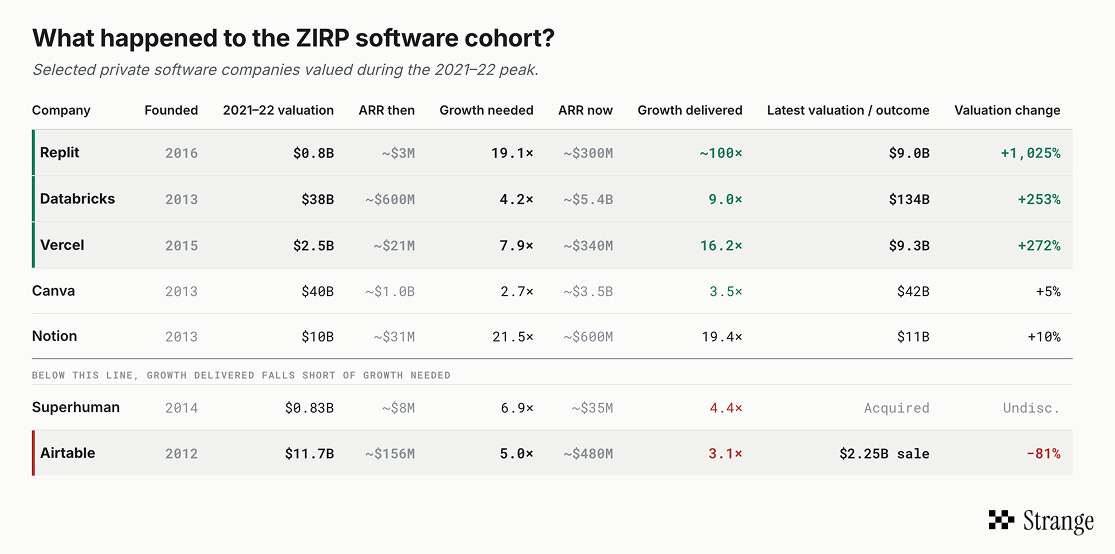
The lesson isn’t simply “ZIRP bad”.
The 2021 market pulled years of expected growth forward into the valuation. Eventually, companies had to deliver that growth. Replit, Vercel and Databricks outran the expectations embedded in their prices. Airtable didn’t.
And in the AI-era, the hypergrowth startups are growing at an insane scale.
Cursor went from roughly $100M to $4B in annualized revenue in 17 months. OpenRouter went from roughly $1M to $140M ARR in 19 months. Windsurf reached roughly $100M ARR before Google struck its $2.4B licensing-and-talent deal.
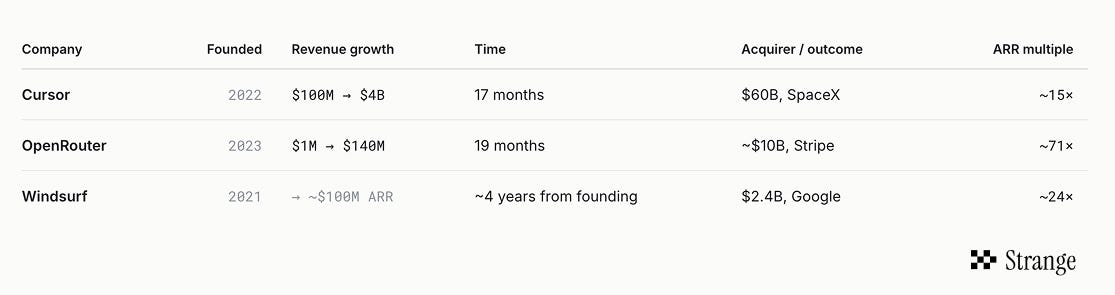
These AI startups are reaching revenue milestones and multi-billion-dollar outcomes in a few years that previously took a decade.
Yes, there’s plenty of froth here too. Extraordinary growth is once again being extrapolated into extraordinary expectations.
But the AI era introduces a strange paradox: it makes it possible to build enormous companies faster than ever, while also making waiting more dangerous. The ground is changing constantly.
That changes the math of an exit.
Venture tends to treat a multi-billion dollar acquisition as the consolation prize to building the large IPO-scale independent company. But when the window itself is moving faster, crystallizing a $2B outcome in year three may sometimes be better than spending another decade chasing an IPO exit window.
AI is compressing both the time to build value and the time you have to capture it.