


In early 2025, a gigabyte of DDR4 RAM (the workhorse memory in cheap PCs) cost roughly $1.40. Cheaper than a cup of coffee. By January 2026, that same gigabyte is trading on the spot market for $9.30. A ~600% explosion in under a year.
Executives from Big Tech are reportedly camping out in hotels near Korean fabs, waiting for allocation meetings. Industry insiders, somewhat derogatorily, call them “DRAM beggars” (first reported in Chosun Ilbo).
What happened here?
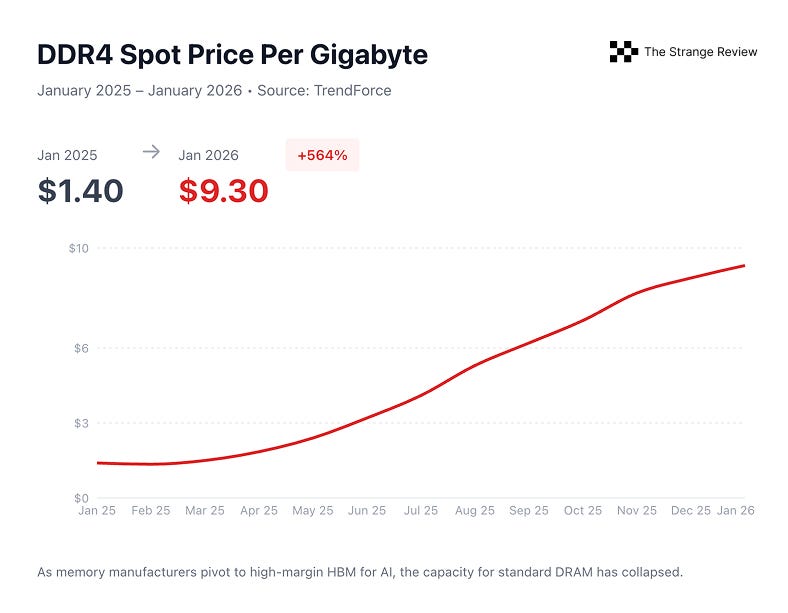
The shortage has a simple, brutal root cause: to build the High Bandwidth Memory (HBM) that powers Nvidia GPUs, manufacturers sacrifice massive amounts of wafer real estate.
HBM chips are larger and have lower manufacturing yields. Producing 1 GB of HBM effectively consumes the wafer space of 3 GB of standard DDR5.
Samsung, SK Hynix, and Micron (who together control 95% of global DRAM revenue)made a rational choice. HBM margins are enormous. Hyperscaler demand is insatiable. So they pivoted hard, and in doing so, they deleted the capacity needed to make memory for everything else.
And Micron, America’s champion and the world’s third-largest DRAM maker? Their fabs are fully booked too. They’ve made the same pivot to HBM.
The AI economy runs on finite resources: silicon, power, water, labor. When one use case can outbid the rest of the economy, something has to give.
We might see the effects cascade:
Consumer lag: The laptop you see on shelves today was built with memory bought six months ago. The real pain hits this year. Major OEMs have warned of 15-20% price hikes. Mid-range smartphones are quietly downgrading to 8GB to mask the inflation.
“In the case of the upcoming memory crisis, this is something that will hit the market hard, especially to [phone-makers] playing in the low end where margins are extremely tight. Those vendors will have almost no choice but to pass the increased cost to consumers.”
- Nabila Popal, senior research director at market intelligence firm International Data Corporation (IDC).
The cloud tax: For the first time in a decade, the raw cost of compute infrastructure is rising. As memory costs flow through to hyperscalers, we might expect that burden to land downstream to cloud customers.
We cannot build new factories fast enough to fix 2026.
As Western and Korean makers abandon the low end to chase AI margins, China’s CXMT (ChangXin Memory Technologies) is the wildcard. They briefly flooded the market with cheap DDR4 in 2024, then pivoted to DDR5 under government direction (to focus on next-gen instead of legacy tech), actually worsening the current shortage. But the long-term trajectory is clear: Chinese fabs will fill the gap Western suppliers are abandoning.
We are entering a world with two distinct memory markets: a high-end, expensive, Western-aligned tier (HBM/DDR5) for AI infrastructure, and a low-end, commoditized market supplied by China for everything else. Your next smart fridge might run on Chinese chips. Because they’re the only ones available under $10.
The Question
The memory tax is a preview of what happens when a single use case: AI, can outbid the rest of the economy for atoms.
Every wafer allocated to an HBM stack for an Nvidia GPU is a wafer denied to the LPDDR5X module in a mid-range smartphone or the SSD in a consumer laptop. This is a zero-sum game at the silicon level.
And the harder question: What else gets crowded out next? Power. Water for cooling. Skilled labor. The AI boom is not happening in a vacuum. It is pulling physical, finite resources away from other uses.
The deflationary AI future may still arrive. But the path there runs through a lot of inflation first.
Thank you, Tara, for raising this extremely important point that the AI boom is not happening in a vacuum. As you point out, we're already seeing large-scale and downstream environmental and ecological risk, something which is only going to accelerate further in 2026 and beyond. I like to think that governments will put some kind of levies on BigTech with regards to AI usage costs, but I live in hope...